
The first queer character I remember encountering in a videogame was Baron in the 1998 N64 platformer Mystical Ninja Starring Goemon . Baron wore blue lipstick and eye-shadow, a single bright red earring and had an asymmetrical hairdo that falls in a wave on one side of his head. His palette-swapped comrades made up the “Flake Gang,” whose Parisian bathhouse theme song features a man moaning “ooh” in its introduction.
Even at 10, I understood what was going on. He was gay. He couldn’t possibly be any gayer. Well, unless the game had actually ever mentioned he was gay. Clearly, Mystical Ninja was playing with camp absurdity but Baron’s effeminate design (just imagine if he’d had voiced dialogue) and theme music were meant to code him as gay for players. But Baron (similar to Tingle in the Zelda series) is never stated as gay. Both his and Tingle’s campy, effeminate designs function to code an identity practically exploding with subtext. But that’s all: no love interests, no clearly stated attractions. These characters only have a subtextual identity. But why? Why feature such clearly queer subtext only to never offer these characters even a passing reference to an actual identity? Are they in the closet? Does the closet even exist in videogames?
The ”closet,” used colloquially, refers to a queer person identifying as heterosexual to evade the social stigmas attached to not being straight. As identified by feminist scholar Judith Butler, it is a highly problematic concept because it lends credence to the notion of everyone being straight unless proven otherwise. A “closeted” individual can only be in the closet if they were assumed straight in the first place. This “straight until proven otherwise” perception places heterosexuality on a pseudo-science pedestal as ‘default.’ In the case of gay and lesbian videogame characters, their sexualities are routinely unavailable unless first activated by the player.
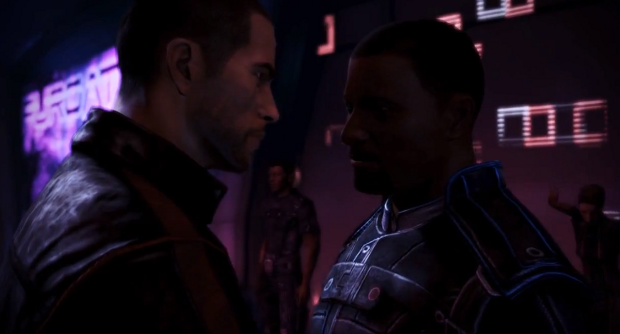
Unfortunately, even more progressive games play this trope (ironically enough) straight. For all the career-ending, lawsuit-filing madness surrounding Mass Effect 3 , the game featured a protagonist that could engage in queer relationships with men or women. Similarly, Skyrim features same-sex marriage (hear that, Scalia?) as an option for all players. However, In both Skyrim and Mass Effect , the player must enact specific dialogue/quest options first to encounter these same-sex relationships, whereas open flirtation is common from female characters to a male protagonist. It’s problematic that heterosexual attraction is compulsory and encountered by players regardless of choice, while same-sex attraction is “unlocked,” instead only encountered under certain circumstances. While some dismiss same-sex attractions in games as having an “agenda” or being “political,” the inescapability of hetersoexuality clearly articulates an agenda of normalizing heterosexuality, to the exclusion of queerness.
Another common dismissal is that there are just are more straight people, so regularly including queer characters isn’t realistic. But videogames, however realistic they aspire to be, exist in a tailored reality. Yes, they have motion capture animations and photorealistic visuals but videogames purposely elide the trivialities of life, either because they’re not conducive to fun gameplay or are irrelevant to the plot. However, the same is done for the enormities of life – including social class and sexuality. This is a big deal because of a universal truth: people are socially situated based on a number of complexities, sexuality included. Society has innumerable mechanisms designed to privilege or oppress people based on their identities. That’s the entire point of the closet: it’s a way of evading the stigma, disdain and oppression attached to a queer identity to gain the privilege (positive representation, social acceptability) of the straight identity.

Fallout: New Vegas’ “Confirmed Bachelor” and “Cherchez Les Femmes” perks coyly introduce homosexuality to the game world without “coming out.”
So, are these mechanisms present in videogames? Do these queer characters exist in worlds where they must hide their sexualities, enacting them through subtext instead? Are they in the closet?
Simply put, some do and some don’t. Mass Effect 3 and Skyrim, both allow for queer champions. Similarly in the Fallout, Dragon Age, Bully, Sims and Grand Theft Auto series, characters (though not necessarily the player) have gained political power without social barriers linked to their queer sexuality. The key difference here is that the aforementioned replication of the mechanisms of privilege/oppression in videogames can only function under one condition: silence. Counterintuitive as it may seem, concealing the presence of these social mechanisms is the only way to enact them. When queerness is reduced to subtext, the same ‘straight unless proven gay’ logic shifts (invisibly) to the forefront. Thus, videogames with openly queer characters in power are presenting to the player a setting that has explicitly denounced barriers to queerness – a radically different status quo.
Why else would the announcement of a “gay” Shepherd have taken 3 entries and caused so much controversy? It changed the universe. But in games that either have no queer characters, or in which these characters enact only subtextual identities,they are filtered through the same mechanisms of oppressive social acceptability which privileges heterosexual identities. This is the closet, a filtering by developers of their characters to sidestep player backlash against queer characters. The closet in videogames is real.
Unless developers choose otherwise. The option for a lesbian Commander Shepherd or a gay dovahkiin dismantles the invisible rules of stigma and shame that prevent queer visibility- the same barriers operating in the “real” world. The aforementioned games highlight the non-existence of barriers based on sexual identity. And while it may not be “realistic” for every protagonist to themselves be queer, simply having this option articulates a refusal to relegate queerness in the gaming world to only subtext and dismissal.
But this goes beyond a call for “diversity” or “more representation” - token queer protagonists or NPCs will not change the status quo. To evolve beyond tokenism, future games must not only feature queer characters with relationships outside the sphere of heterosexuality, they must articulate and denounce compulsory heterosexuality. In this instance, Mass Effect 3 may be the most inclusive AAA game of this generation, as Shepherd becomes the savior of the galaxy having openly dated both men and women. As Butler and many other feminist scholars have written, it is silence that allows these ideologies to function invisibly as unquestioned assumptions as the most nefarious concept of all – “natural” (or as gamers like to say, “realistic.”) We need characters who love openly to rebuke the status quo. This evolves queer discourse in video games beyond idealism enacted in a fantasy sphere to a critique of the nexus of assumptions which form the ideology that creates the climate for the closet. And certainly Bioware, Bethesda and a small handful of other developers have taken a small but very important, step forward.
Further Reading: Dismanting the Default: Homophobia, Feminity, Misogyny and The Default in The Gaming “Community” (Medium Difficulty)

