
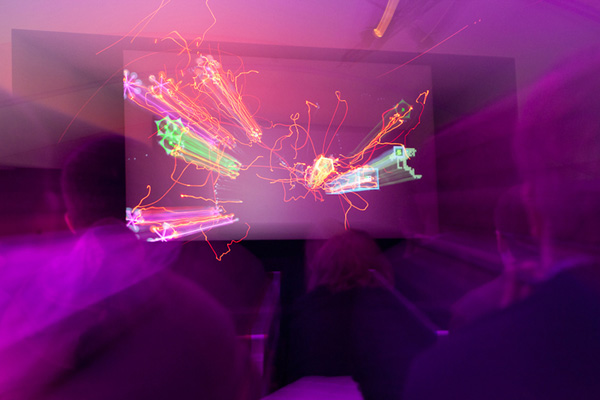
Renga is a video game unlike any I’ve ever experienced before. I was lucky enough to attend the first screening of wallFour’s remarkably unique videogame/film at the Toronto International Film Festival Nexus 2012. Renga is a 100-player interactive film: narratively, it’s about a spaceship that gets attacked and waylaid and is seemingly lost to rot in the outer reaches of space, unless it can rebuild it’s engines and fly back home. Everything is controlled by the audience members, who are armed with laser pointers and must collaborate in order to rebuild the ship, defeat the big bad boss, and fly back home.
Here’s the experience: imagine sitting in a theatre, with ninety-nine strangers. You’re all shouting, trying to form a cohesive plan of action in order to attain your goal (which was familiar – I grew up with approximately a million older brothers, and the experience was not dissimilar). Now imagine even trying to get half of the audience to agree on a plan, let alone everyone. Anyone who has ever played New Super Mario Bros on the Wii, and has had their partner shout at them to “Stay in your bubble!!” will understand the enormity of this task.
Now, imagine that your avatar is only a red dot, the product of the laser pointer in your hand. Your dot looks exactly like everyone else’s dot. Add a sarcastic robotic voice commenting on your team’s ability — or inability — to work together, and you’ll understand why Renga is hilarious amounts of fun. And an entirely unique gaming, and film, experience.
But what I found to be the most interesting aspect of Renga — beyond the quirky social experimental aspects, of course – was how it reconfigures the notion of the player. In Renga , your avatar (i.e. laser-pointer controleld red dot) only matters in so far as it functions as part of the whole. You are the Borg. Resistance is futile. Unlike in other multi-players, you cannot accomplish anything on your own. There were many times playing co-op in games like Borderlands and Gears of War I would argue with my partner over who would get to deliver the final blow to the boss, since we both wanted the glory of being the “hero.” (I’m a lot of fun to play with, guys, I promise.) This isn’t even a possibility in Renga ; you can’t kill an invading enemy ship without at least two other players joining you in the attack. And in a room of one hundred people, trying to organize this becomes both insane and an accomplishment in and of itself.
You don’t know who is controlling the other red dots that are assisting in your successful defence of your spaceship. The role of you as a player becomes completely transformed into a collective collaboration: you have to listen to your fellow team-mates and you must work together. Rogue players will pop up, but unless they form their own mutinous faction, their efforts will not deter the entire unit.
While my team-mates and I did not have to deal with a rebellious squad of treasonous red dots, we did have our own disagreements about how to best handle situations. When we were trying to harvest “quads” to rebuild our spaceship, we would also get ambushed and attacked by the local Cylon-esque ships. Whenever an enemy ship would float onto the screen, all 100 red dots would scramble to destroy the invader, leaving our ship left to wallow and the resources to float off screen, lost in deep space. Eventually, one player shouted: “all men harvest the quads, while all women attack the incoming ships.” (Look how progressive we were!) And it worked. But only because everyone in the audience agreed to this course of action, and worked together accordingly.
In addition to this, many times throughout the game, I thought was in a particular place, trying to achieve a certain goal, only to realize I was actually on the other side of the screen doing sweet nothing to help win the game. So when I was shouting at people to kill the invading spaceships, I was actually yelling at my own dot. There is no individual player, no Commander or Captain in Renga: it is disorientating, invigorating, and the sense of accomplishment when we figured out how to destroy the boss and fly back home is unparalleled.
Oh, and I forgot to mention: you’re not told anything. The only rules the Renga creators impart are that you can shout and talk as loudly as you want, despite being in a movie theatre where the protocol is absolute silence, and you’re informed of the narrative: you are a spaceship, and the spaceships with the grey circles are trying to blow you to smithereens. Learning how to defeat these space invaders is left entirely up to the audience’s smarts and collaboration. And believe me, halfway through the game, we were still figuring out — arguing over — all the nuances of the gameplay. And this was the most remarkable aspect. Everything we accomplished we accomplished through trial and error and communicating with each other.
We laughed. We got angry. We made-up. We won. We could have kept failing, we could have gotten angry at each other and given up. But we didn’t. And when our spaceship successfully blasted off into the safe recesses of space, the cheers and claps were thunderous and genuine. Renga illustrates what I love about video games: unlike any other medium, gaming is a platform for forming bonds that, however temporary, are meaningful and real.
Further Reading:
Journeys: A Curated Collection of Writing on thatgamecompany’s Journey (Medium Difficulty)
Talk Tough: The Language of Play in Final Fantasy XI(Medium Difficulty)

