
Heather Hale
Since his first appearance in 1981, Mario has died a staggering amount of times. Death in video games comes in many forms: falling prey to a mighty dragon, accidentally walking into a hole, or being killed by some anonymous soldier controlled by a guy in Norway. This video game death, or the possibly of this death, is something all gamers have to face almost each and every time they pick up a controller. From funny, to mundane, to frustrating as all hell, these small deaths can make us react in many different ways.
More often than not, the most fundamental concept in a game is to kill or be killed by the enemy. Whether it’s stomping a Goomba or shooting a zombie, you are ready to attack without hesitation. Games let you become the justified hero who has all the reason in the world to kill the bad guys and save the princess. Sure, you might know the rules and the game mechanics, but the stakes can vary greatly when it comes to your untimely videogame demise.
In a series of articles, I will take a look at some of the different experiences of dying in platformer/adventure games, first person shooters, and in RPGs. This analysis is based on my own experience and a group of fellow gamers I have surveyed about their experiences with death in these different styles of games.
Falling Into Holes: Death in Platformers/Adventure Games
In platforming/adventure games the hero becomes your physical extension into the world of the game. For some players, you can feel bodily tension every time you press that button to jump over a hole or shoot at an enemy; in this sense, each death becomes a small manifestation of your failure to complete a systematic process. Like missing a shot at basketball, these types of games provide the opportunity to quickly grab the ball and try again, which makes each death frustrating, but not capable of ruining your day — mostly. Things like checkpoints and frequent auto-saves in modern games help ease the frustration and tension of constantly dying, as well.
These types of games allow the player to improve with time and practice, essentially transforming the game into one of testing and redefining the limits of the system with their own skills. The amount of disappointment a player is exposed to when dying while they are acquiring these skills can vary greatly from mild annoyance to a feeling of complete failure, depending on the person. Even the most experienced player is not exempt from the frustration of failure.
When playing one of these games, the physical flow of moving through a level is very important in completing a challenge. The interruption of death takes the player out of that deeply immersed and physical state of being. The stunting impact of a death — or especially a Game Over screen — can vary greatly depending on the game’s execution. For example, in many old platformer style games the number of lives you have are limited, and hitting a Game Over means sitting through a graphic/cut scene, which rubs your failure in your face.
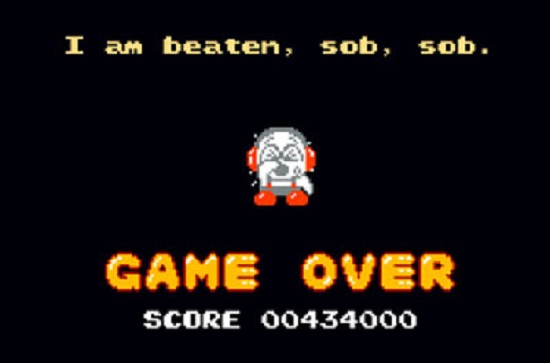
This is unlike newer games, wherein you are immediately restarted at the last checkpoint with no further reminder of your failure. The frustration of staring into the face of failure, like watching baby Mario being taken away in Yoshi’s Island , compared to instantly restarting a super fast-paced and short level, like in Super Meat Boy, are incredibly different experiences.
When I asked participants in my Game Over survey how they felt about these different types of consequences, there were varying responses. But there was always a difference in reaction to the different styles of game deaths. One participant noted, “If I die quickly over and over I will be more likely to keep trying but if I invest a moderate/long amount of time and fail repeatedly, I would quit after lessattempts.” Another commented that the severity of older style Game Over screens had more of an effect on them: ” [They make me feel] disappointed, mostly in myself. I feel like seeing ‘Game Over’ is a commentary on my video game-playing ability.”
Although, on the other hand, some commented that the pause in play dying forces gave them the time they needed to cool down: “I feel that a longer Game Over screen gives me more time to compose myself for a retry. I usually take this time to think about whether or not I want to continue or approach the level differently. I feel rushed with the faster reloads, much like in an arcade setting.”
Many players also commented on the aggravation of dying because of ”cheap kills,” due to game glitches or ill-conceived programming, opposed to a more deserved death from a fair, but challenging level. The idea of an unworthy death can of course stem from player error as well. The image of themselves as an unbeatable hero is no doubt hindered when a player accidentally walks into a hole or fails at a simple task. This kind of loss can undoubtedly be frustrating, especially when a long Game Over screen rears it ugly head. Luckily, most platforming/adventure style games provide you the deep immersion that keeps you playing for a long while before throwing in the towel, even when you must confront your failure briefly before moving on.
Tactic and strategy is required and, although the fluid ability to physically perform is key, the player must lull themselves into a state of complete immersion in the game in order to be successful. When it comes to this type of game we are a slave to the system. There is no time to think about the consequences of our actions — and really no need to do so.
Although we like to think of ourselves as the controllers of game worlds, in truth they are usually controlling us, helping us perfect a specific skill set to be more in sync with the machine, in that “Gaming is a pure process made knowable in the machinic resonance of diagetic machine acts; gaming is a subjective algorhythm, a code intervention exerted from both within gameplay and without gameplay in the form of nondiagetic operator act; gaming is a ritualistic dromomen of players transported to an imaginary place of gameplay” (Alexander Galloway, Gaming: Essays on Algorithmic Culture ).
This brings into question the true veneer of the control that games give to the player. We are being told what to do, and obeying the constructs of the systems whether we like it or not. The amount of control over a game we have (aside from choosing whether or not to play) is always incredibly minimal. Luckily for us, they are still a lot of fun, letting us become a hero and increase our skills within a fantasy world.
For next time, I will continue by discussing death in first person shooters.

