
Adam Maresca
It should have been so simple.
It was billed as a greatest-hits mash-up of two games that were pivotal in the collective game memory of millions. Installments in a series which charted the high water mark of extreme sports in the public conscience. Five little letters, three score targets, two minutes; arguably pieces of a video game lingua franca. All that it needed was a fresh coat of paint, a re-licensed soundtrack, and online support for what was already fondly remembered.
As the details were released and the embargoes went up, the bad news came in. The engine was redone in Unreal and came with its own litany of mechanical foibles. Old techniques don’t work right, a couple of grantable edges don’t connect the way they should, you bail through the world geometry a lot. Neither were the more cosmetic details spared from alterations. The roster of skaters is populated with unfamiliar faces (and missing many memorable names), the small list of included levels is hobbled by omissions, the secret VHS tapes have been changed to DVDs.
Using tetchy controls to navigate a world of unfamiliar elements, mixed with altered signposts of the past, creates a corrupted jumble that recalls the moment someone realizes they’re dreaming. The Hangar being in the same collection as the Warehouse just highlights how much of the latter’s structure is in the former. The attention to graphical fidelity highlights how thoroughly unrealistic the dimensions of the world could get in the service of a more fun level. Venice Beach is cast in a kind of sickly red-brown glow of twilight that looks like a parody of a Black Ops II lighting engine test. Did I mention they turned the tapes into DVDs?
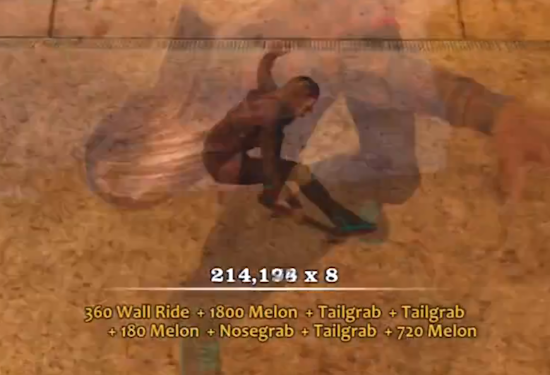
These alterations, however, are dwarfed by the absences. A game modes as time-tested as H.O.R.S.E. gets the axe, there are no medals to earn in Marseilles, the out-of-bounds messaged politely pop up along the side of the screen instead of bleeding front and center to shame you into not doing that again. There are no parks to create, and creating your own skater has been supplanted with avatar support. There’s no skate footage to unlock and watch, which was a nice touch to remind you what the real deal looked like after sessions full of ludicrous feats. There was something endearingly noble watching Neversoft employees scrape their knees and eat grip tape on mini-ramps. There was the spark of life in those early games, and the handprints of a team in love with their creation, where HD never got the time, funding, or freedom to let that come out in Robomodo’s contributions.
And then there was that element that was a pillar of the consummate Tony Hawk experience etched into players’ memories: the songs. The soundtrack was the right size, but only one song came from the original Tony Hawk’s Pro Skater (“Superman”), and half of the remaining songs were new inclusions. Timothy Seppala of Sound and Vision Magazine interviewed Robomodo project manager Ken Overbey and lead designer Patrick Dwyer about their thought process curating the soundtrack. There’s much to be lauded about their intent to, in Dwyer’s words, “figure out songs that everyone would like” regardless of genre preference, and to seek out “timeless” songs “that sounded like they could have been in the old game,” but you get the impression that perhaps they misjudged.
Messing with shared memory is a minefield, and music is an inexorable part of that; trying to astroturf emotional attachment is nearly impossible, and trying to catch thousands of people with the same trick is completely impossible. Dwyer asserts that the first game “was all punk songs and rock songs, the same sounding stuff,” but for some people that’s selling short the distance between the Dead Kennedys, Primus, Unsane and the Ernies. You might also be inclined to question their judgment criteria: where they chose songs they found worked well in the game and filled in perceived genre gaps, the reason for that sense of homogeneity in the old games were the ties those songs had to the wider subculture on display. It just adds to the overall disconnect that the game creates as it splays out across millions of garbled memories.
The flip-side is that, for some reviewers and fans, all these distortions still keep acceptably close with their recollections, or might even move HD closer to “accuracy” on their terms. Perception is fallible, and as years passed and levels made other appearances in other games with other score mechanics and soundtracks, memory alone grows more and more unreliable. Everything from level objectives to which game a song first appeared in to how wallies handle gets refracted through each level in an individual’s personal flashbacks. When trying to judge the success or failure of a game like this, allowances for the limitations of the past become entangled with whatever the final verdict is; revisiting the past isn’t just following through on nostalgia, it’s fact-checking. Which then leads to Tony Hawk’s Pro Skater 2X.
As a modified and bundled port for the newly debuted Xbox, 2X was a stopgap before the third game, but now it is both an accessible yardstick to measure HD with, and a product that aims to fill the same niche. And many who have found copies of it have found this decade-old disc to be the better game: all levels from both games plus five extras, a roster of skaters in their prime and of the era, the same courtesy of a grind balance meter that HD includes, and so on. Had Activision simply ported (and maybe re-skinned) that readymade collection, they would have been able to keep the finely-tuned controls that made those early games some of the highest-rated of their time. Maybe then the passing of time would be far kinder to any shortcomings, instead of being held to the scrutiny of the here and now that a ground-up rebuild invites.
As it stands, the past and the present dilute one another and leave HD whole game muddled and lifeless. The competing pushes for nostalgia, modernity, exaggeration, and realism refuse to allow Pro Skater HD to gel into anything resembling a cohesive whole. The disparate parts feel like someone trying to inuit an inside joke; they know the general form, but the key details escape them. Even given their limited resources as a downloadable title, their adaptation feels wanting, slowly becoming buried under a pile of complaints that might seem fussy on their own. Some of things people were expecting might even be wholly unfair, a product of their own confusion of memories about various Tony Hawk titles, but that’s baggage that comes with the territory. It’s what happens when you double down on people’s memories of the past and then play it loose with that history.
Further Reading: Tony’s Busy (Kill Screen)
, , (Youtube)
