Hired Guns: The Real Price of Game Violence
Adam Maresca
America is slowly recovering from a flashpoint of public violence. Having learned nothing from the , our news media has fostered an environment for a succession of copycats in the slaughter of the innocent. Motives may be varied, but the yield of needless death has come due in Oak Creek and Aurora in just the past month alone. In that last case, even through something as innocuous as
Guitar Hero
, again video games have wormed their way into dialog over American gun culture.
It is in these times that EA’s
Medal of Honor: Warfighter
is under (well-deserved) fire for their
strategic sponsorships with gun manufacturers
. Including links to websites where weapons found in-game can be made to order and purchased for real-world ownership should be the kind of crass behavior more thoroughly decried, but that isn’t the world we live in. There’s a gulf in difference between
a Porsche and tomahawk
, so it’s probably for the best that there are at least half-measures being taken in response to criticism. Licensing the likenesses and brands of real guns isn’t new or shocking by any stretch of the imagination, but the shamelessness of the cross-promotion is worth a few red flags.
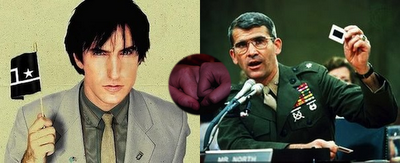
This isn’t the only dubious partnership recently fostered by a triple-A shooter, either. Several weeks ago, Trent Reznor of Nine Inch Nails happily made public his soundtrack work for
Call of Duty: Black Ops II
. We’re a long ways out from
Quake
, and everybody from
HEALTH
to
David Bowie
has tried their hand at video game soundtracks in that time. Those soundtracks, however, didn’t involve going against the image and ideals you’ve come to espouse over the course of two decades. Who knows, maybe there’s some hidden dimension of meaning that comes with sharing space on credits with a man responsible for
selling arms to Iran
to help fund to Nicarguan guerillas who
murdered nuns
. Or it’s a paycheck. “Bow down before the one you serve” indeed.
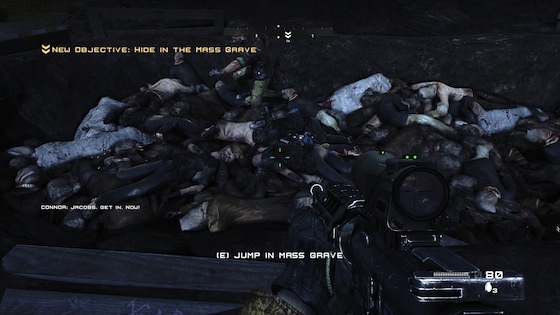
In essence, these sorts of reprehensible marketing bullet points are the endgame you get after competing for the worst atrocity developers can get a player to commit as part of a military FPS. There’s a through-line running from the sensation caused by “No Russian” to the revolting artlessness of the ‘hide in the mass grave’ objective in
Homefront
to the
debunked
faux-profundity of the white phosphorous civilian attack in
Spec Ops: The Line
. The boogeymen are almost always poor and/or foreign, and the leader soldier of the heroic superhuman squadron is a white male brunette with equal frequency. Because being blonde and blue-eyed would be a little too overt for the 21st century.
The reason these are the game we talk about are because of the magnitude of their commercial and critical success. (Or failure, in the case of
Homefront.
) There have been forays into video games by organizations with even more blatant agendas. There was the Kinect-supported game glorifying the exploits of
Academi
,
née
Xe,
née
Blackwater
. It was fortunate, then, that compounded with the disgusting heritage of the game, it also happened to be an
utter failure
. Of course, when that same intrusion of reality happened for the three-game
America’s Army
series on PC, there was far less of an outcry. Even if it has been a few years since an installment and the daily player base is only three digits, the presence within the industry is felt at all level. Their ads find their way into other games and on “gamer-friendly” networks like Spike and G4, and recruitment booths are always fairly easy to find on the floors of major conventions. Even if they don’t come away with much meat for the grinder, this is one of their primary bases of support.
These are the words of
President Dwight D. Eisenhower
, speaking in 1961 on the changes seen after World War II and in the time before, during, and after his term in office. In in speech, he takes a great deal of stock in his 50 years of service in some capacity.
In the councils of government, we must guard against the acquisition of unwarranted influence, whether sought or unsought, by the military-industrial complex. The potential for the disastrous rise of misplaced power exists and will persist.
We must never let the weight of this combination endanger our liberties or democratic processes. We should take nothing for granted. Only an alert and knowledgeable citizenry can compel the proper meshing of the huge industrial and military machinery of defense with our peaceful methods and goals, so that security and liberty may prosper together.
This excerpt is commonly cited as one of the earliest warnings of the influence that the burgeoning military-industrial complex would come to possess. What is often omitted, however, is the segment directly preceding it.
Until the latest of our world conflicts, the United States had no armaments industry. American makers of plowshares could, with time and as required, make swords as well. But now we can no longer risk emergency improvisation of national defense; we have been compelled to create a permanent armaments industry of vast proportions. Added to this, three and a half million men and women are directly engaged in the defense establishment. We annually spend on military security more than the net income of all United States corporations.
This conjunction of an immense military establishment and a large arms industry is new in the American experience. The total influence — economic, political, even spiritual — is felt in every city, every State house, every office of the Federal government. We recognize the imperative need for this development. Yet we must not fail to comprehend its grave implications. Our toil, resources and livelihood are all involved; so is the very structure of our society.
To this day, the realities of those figures have not changed much; though
second overall to Social Security
, defense spending tops the amount of
enacted non-mandatory spending
at more than eight times the next category. And you’ll never hear any one in any branch of government attempt to so much as suggest making cuts or adjustments there. Not even
faulty planes
many active officers suggest getting rid of are up for debate. This all in spite of the contention in the last decade over the dealings of private contractors from no-contest Halliburton bids to debacles like, say, Blackwater for instance. In today’s climate, saying anything even remotely critical of the actions or operations of our armed forces is tantamount to political suicide.
And why is that? Because, like any industry, contractors and manufacturers have worked very hard with their counterparts in the service to keep it that way. The same way ousted office-holders on Capitol Hill seem to find their way into lobbying firms, so do honorably discharged or retired members of the elite ranks of the armed forces. Their spending, plus efforts by the Department of Defense’s own Public Affairs office, go towards cultivating that supportive immunity. And where better to invest a sizable chunk of that effort than a hub of boys and young men with insatiable power fantasies?
But these agendas don’t stand in a vacuum, and there’s nothing preventing equipment manufacturers from latching onto that goodwill and piggybacking in search of civilian customers. The myth of “just war” gives innumerable companies a
fiction
they can use to sell their wares to the public, and blockbuster war franchises are a sizable piece of that puzzle. And it doesn’t matter how far removed from the truth those fictions are, because they will
still color our perspective
in some subtle way.
This is why the ways we approach games like
Medal of Honor
and
Call of Duty
are crucial: not because they dictate who is going to go on a rampage, but because they’re a part of a larger cultural mechanism which dictates how we view both military and private violence. We have to stop and ask what kinds of people will be spurred to buy promoted weaponry, and what their motives and expectations might be in the face of who referred them. It’s about being honest with ourselves as a nation and tacking stock of our collective mores; it’s about trying to get around hundreds of millions of dollars of spin and damage control and closer to something resembling the truth. Lives might be at stake.
Further Reading: Response:
Call of Apathy Advanced Warfighter (Medium Difficulty)
This entry was posted in
Critical Conversation
and tagged
Academi
,
Adam Maresca
,
Blackwater
,
Call of Duty
,
Gaspar Lewis
,
homefront
,
Mass grave
,
Medal of Honor: Warfighter
,
spin control
,
Steven Spielberg
,
Trent Reznor
,
Xe
. Bookmark the
permalink
.

