
Going in I had heard rumour that there was an uncomfortable, anachronistic moment in Deus Ex: Human Revolution . I was vague on the details, but had a faint recollection that a number of players had expressed discomfort with some minor aspect of the game. I even remembered hearing that this mysterious element was considered by many to be a blemish on the otherwise elegantly realised vision of the future that developers Eidos Montreal had sculpted.
Over a year after everyone else had watched the final credits roll, I finally set aside to sink into the game myself. I move around that wonderfully sombre, burnished gold space, stunned by the whole game’s noir-inflected cyberpunk aesthetic, thrilled utterly with the rich potential of the narrative and game-play that stretched out before me. But still, nagging at the back of my mind like some glitch in the Matrix, I wonder: what on earth had people been complaining about? Because whatever it is, I’m not seeing it .
Is it Jensen’s voice?
Sure, it he probably is a little too Clint-Eastwood’s-Man-With-No-Name from the Fistful of Dollars trilogy. If you swap out the poncho and replace it with a pair of Swiss-Army-Cylon-Arms they would be virtually identical. ‘I didn’t ask for this…’, Jensen would rasp around a chewed up cigar, his voice crunching like a handful of gravel.
Is it the unnecessary, slightly obnoxious sunglasses?
I mean, okay, fine – a little pretentious. But hey: people can have sensitive eyes. Even at midnight. In Detroit. In a dark alley. Hiding under a box. …And maybe getting completely-shot-to-death and rebuilt by the clandestine machinations of a corporate overlord can cause scratched corneas or something? Robocop went with a visor too, after all. Who am I to judge?
Surely it couldn’t be the cityscape…
Yes, maybe the streets of a future American metropolis are a little barren of moving cars. And all pedestrian activity does seem to be rooted in redundant behavioural loops. That same couple has been arguing about that same traffic accident for quite some time now. That hotel cleaner has been loitering in place for days, and he clearly didn’t bring a magazine to read or anything. And sure – I hear it – a lot of voices and dialogues are getting rehashed…
But come on .
A grumbling monorail glides overhead. Police officers patrol ominously, poised for the ideological riots that might break out at any moment. Street punks that appear to have wandered out of Michael Jackson’s ‘Bad’ video clip by way of Philip K. Dick pepper the back alleys, warming the night air with the glow of their cigarettes. No, if there is some weird aberration in this glistening techno salad it has completely passed me by; for a projected, fantastical environment, Deus Ex’s dystopian vision feels wonderfully familiar and alien all at once.
In fact, Deus Ex contains perhaps the most beautiful, absorbing art direction I’ve ever seen in a videogame. With its honeyed techno conflagration of society, it’s worn-in, decayed futurism; its characters nonchalantly sporting or debating upgrades and optics and augs; walking around this world, watching though Jensen’s gold-tinged visual display, I feel like a mosquito suspended in amber: the relic of an age that has passed, watching a new society swirl into view just beyond the confines of the screen. I can almost feel the pistons and pressurising fluids pumping through my limbs, almost tingle with the hum of nanotech under my skin. I may even be a little worried about what that discoloured rain is be doing to my swishy leather coat…
“ Well, sheeyit! If it ain’t the Cap’n, hisself!”
And I ask myself, “What the – ?”
“ Mister Sarif done fixed you up good, ain’t he? Give you a new set of glasses an’ everythin’! Damn …”
In my usual borderline OCD game-play, I have been clicking on every container and NPC in sight – and apparently the speaker is the middle aged homeless woman in front of me, with her hands at this very moment plunged into a garbage can.
And hey: I’m not judging . I had just been fishing through that same canister in the hopes of finding stray consumables.
(Speaking of which, why does Jensen – a man working for the wealthiest company on the globe – need to scrounge for discarded candy bars? Is there seriously no expense account for the one guy you got covering your multibillion dollar global enterprise?! )
Anyway …
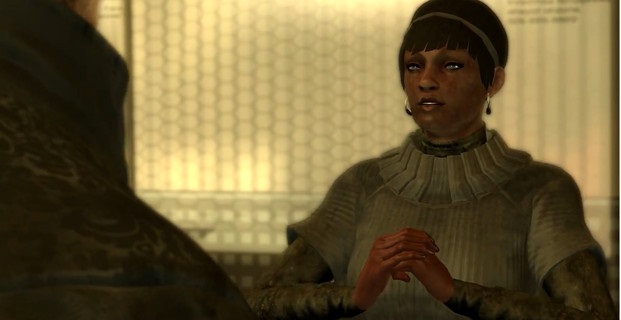
Her name is Letitia. An African American woman dressed in a dishevelled pull-over, with cool grey eyes and no discernible augmentations – she looks like any other figure huddled away from the chill of the streets. But her voice …
I cannot exaggerate how overwrought her dialogue and its delivery is, because there is literally no way to over-emphasise her cartoonish inflections. (Indeed, the snatches of dialogue I am recounting are lifted, unaltered, from the spelling of the game’s own subtitles. You can see video of the exchange with Letitia Barring the possibility of Cletus the Slack-Jawed Yokel making an appearance in a later boss battle, her speech (unlike any other figure in the game, including the other homeless people that pepper this level) remains by far the most flamboyant caricature I have stumbled across.
Now, at this point, I want to make it clear that I have no interest in making a statement as to whether I personally think this characterisation is racist. I do – but that’s not really the point that I want to explore here. For those interested in this debate there are a wealth of such readings and number of critics interpret Letitia as a pastiche of every insulting, culturally vilifying stereotype that one would have once heard in the grotesque, blackface minstrel show.
As those interpretations have pointed out, she says ‘pacifics’ instead of ‘specifics'; drawls ‘So whatchu wanna know?'; and vacillates in an hysterically inflected patter:
“ Didn’t think I’d see YOU walking this boulevard any time soon, that’s fer sure. Not afta what happen six months ago. People said you’s down for the count…”
But, once again, while sadly I think there is a wealth of worthy, and necessary, questions to ask about the racial stereotyping of such a character; however, for the purposes of my discussion, I will put that loaded issue momentarily aside. The publishers of the game, Square Enix, when asked for a comment on this peculiar characterisation, responded by saying :
Deus Ex: Human Revolution is a fictional story which reflects the diversity of the world’s future population by featuring characters of various cultural and socioeconomic backgrounds. While these characters are meant to portray people living in the year 2027, it has never been our intention to represent any particular ethnic group in a negative light.
And thankfully there are other African American characters within the game – business people, police officers and scientists – who reflect more varied personalities. What baffles me about Leticia is how she recalls those two ‘comic relief’ robot twins Michael Bay loaded into his second Transformers atrocity and was how antithetical her depiction is to the overarching themes of the Deus Ex ’s narrative, both on a practical and conceptual level.
Letitia functions as font of contextual information. She’s portrayed as a person from the street, one of Jensen’s old informants from his days as a cop; in other words, she is a figure who might offer the player a fresh perspective upon this unfamiliar new culture. But rather than presenting a unique glimpse into the world of the haves through the eyes of the have-nots , instead we get a character largely ignorant of the social structure. Rather than a window into this world she becomes set-dressing, a potentially unflattering reflection of the developer’s vision of race and class, concerned primarily with the acquisition of alcohol and spare change.
Indeed, in her third line of dialogue (ironically, in response to the suggestion that that people underestimate Jensen), she replies by begging for money:
“ You an’ me both, Capt’n! You an’ me both! Uh, you, uh… got any credits you can spare?”
And if the player goes to some effort to deliver her four beers (of the brand that she likes), she eventually responds:
“ Damn’ Capt’n. You knows how to warm a girl’s insides! Here. You takes this. I founds it on Brooklyn Court, near the basketball court. Thought I might hold onto it, ‘case I needed to crawl inside some rainy night. But maybe you find some use for it instead.”
So while it is superficially courteous that Letitia is offering up a cache of goods to Jensen, the literal trade occurring here is the exchange of shelter for alcohol . She happily forgoes accommodation in order to drink herself into oblivion.
This is not the researched, artful dialogue of the corner-hoppers on The Wire ; instead it feels rather more like a gauche, ignorant stereotype:
“ Oh, things ain’t looking good, Capt’n. People losing their jobs… their homes… Locking everything theys own inta those, uh, garage-door storage units ’round town, hoping nobody breaks in an’ steals stuff. Mr. Sarif gonna save us, he better do it soon.”
It’s not even clear that she understands the augmentation debate that festers at the very core of this societal unrest, even referring to Jensen as “an adventuring man … fixed wit’ suma them fancy technolimbs Mr. Sarif makes…”
Most peculiar of all, however, on the larger thematic scale, falling back on such dated, outmoded caricatures works in complete opposition to the subject matter of technological and ideological evolution that Deus Ex claims to be exploring. For a narrative fundamentally concerned with blurring the divisions between man and machine, biology and synthetics, suddenly finding oneself face-to- face with gaming’s version of Mr. Yonioshi from Breakfast at Tiffany’s is an ugly fissure in the game’s otherwise finely wrought artifice.
On most every level Deus Ex dares its player to move their ideology beyond rigid, old-fashioned modes of thought, to not remain mired in conventional or tediously out-dated presumptions. Life, it argues, can no longer be shackled by the biological metronome of a heartbeat. Identity and thought can are easily tethered to electrical impulses and grey matter. The delineations between humanity and machine, good and evil, advancement and regression, gender and sexuality, all are, or are becoming, inextricably, immutably, blurred.
Except with Letitia.
Here, in this one bizarre pocket of dialogue, wherein two characters shoot the breeze over the contents of a trash can, all of those notions of diversity and progressivity, that whole sombre panoply that the game’s designers so skilfully crafted, is momentarily jettisoned and replaced by a garishly reductive cliché – a stereotype that, like the bottle of Hot Devil Ale Jensen retrieved from another pile of refuse a few streets over, should have remained discarded.
Further Reading: The Worst Thing About Deus Ex: Human Revolution ( Time )
Masculinity and the Embodied Machine in Deus Ex: Human Revolution (The Border House).
