
by Edcrab
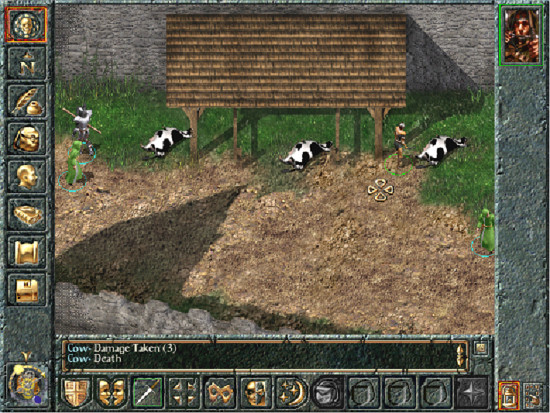
A little after its release, my dad played Baldur’s Gate. I remember him being amused that hitting livestock with a quarterstaff had shifted his reputation to that of a heinous slayer of innocents. Wanting to know exactly how much harm he was doing to said cows, he checked out his weapon’s stats.
“What’s a d6?”
In a fit of rage I threw him out the window and then told everyone on Facebook, which existed back then if you knew where to look, what a newb he was and how I’d totally owned him, and then I got all the likes.
After my father had dusted himself off and we cleared up all the broken glass, I explained the term’s origins. He seemed quite happy to accept that it was shorthand for a six-sided dice, and therefore designated a value of one to six. And then he cursed the Flaming Fist for being unfair.
Anyway, I haven’t seen a d6 for a while, at least in computer RPGs. You’ll see damage ranges of 20-58 instead of 2d20+18, you’ll see attacks listed with a 10% chance of a critical instead of a 19-20 threshold.
That’s mostly because not every CRPG is so steeped in tabletop mechanics, and it tells you the exact same thing regardless. Less a shift in attitudes and more a shift in franchises, but thinking back to my dad’s computerised animal abuse reminded me that there’s a whole lot of terminology out there that must be dense and alien to people unfamiliar with gaming. As can be the case with any hobby.
It’s sometimes easy to forget that every single game that comes out might be, for a particular person, their first ever game. It doesn’t matter if it’s an obscure second sequel or the best known example of its genre; they, the player, may have never fired a bazooka in anger before. They might think hadouken is synonymous with gesundheit. All the language, all the techniques… completely new to them.
Once upon a time my younger self was trying to get Hare Raising Havoc (and the bundled Sound Source peripheral) running after misplacing the manual. I felt like some sort of tech wizard when I finally figured out what made DOS tick. Or Run, as the case may be. You might say that a more sensible child would’ve just got their parents to fix it, to which I say… well, yeah. I’m the son of the dreaded Cow Slayer, what do you expect.
As barriers to entry go, it’s simpler to get PC games running these days. Day Z— a modification for ARMA 2 which I’m yet to sample, but I’ve been assured that it’s a bona fide Good Game and not, in fact, a rapper— has prompted much in the way of technical queries around the internet, with new players troubleshooting issues for a process that’s a tad more involved than most installers. But from what I can see people are more than happy to lend a hand. Lots of support and advice. But not everyone is so tolerant of unfamiliarity or lack of skill.
If you’ve been playing first person shooters since the days that crates in a crate-shaped room counted as level design, then I’ll hazard a guess and say that you probably possess a better aim than someone who thinks of photographs when they hear the word headshot. And the likes of Team Fortress 2, a game that released with no manual or tutorial beyond loading screen tips, were very much created with that kind of veteran in mind. Someone familiar with team-based multiplayer FPSs… in essence, someone who’d played its progenitors. Shock horror, a game with a 2 in the title expected us to have some familiarity with what came before, but later down the line Valve still saw fit to add a shooting range and bot support for practise.
There’s an unfortunate tendency for people online to assume incompetence or even malice on the part of inexperienced players who are struggling to hold their own. Or perhaps they’re just being arseholes, I don’t really know.
But generally I feel like it might help for the game itself to address this. If the game’s mechanics actively allow an underperforming (or let’s face it, out-and-out bad) player to penalise their team and benefit the opposition, to the extent that they can be construed as a griefer or feeder or whatever, then I can sympathise with anyone wary of diving in.
Conversely, I can therefore understand the “elitism” of those who’d prefer to stick to private servers. I’m not a fan of friendly fire on public servers, I’ll admit that much. Clearly the problem with multiplayer games is that there are multiple players to ruin your fun.
But I can’t understand anti-inclusivity sentiment as it pertains to singleplayer. With singleplayer there’s only yourself to blame! Also the game itself. Whatever.
Lacking human players to lambaste, design decisions intended to give singleplayer games broader appeal enter the line of fire. Multiplayer modes make similar concessions, but I rarely witness such wrath directed at them; matchmaking services angled so that newcomers aren’t put up against experts, tutorials for people unfamiliar with the genre, passworded servers so that communities can have private matches without their own team mates perforating their skull…
But when a singleplayer game has an entirely optional feature that’s interpreted as pandering to a more casual player base? Oh, the heavens are filled with fire and brimstone as lightning splits the sky. They’re having fun the wrong way. The developers have forgotten their real demographic.
Fast travel in Skyrim’s massive open world, streamlined narrative options in Mass Effect 3, and sometimes even the mere presence of an “Easy” mode prompts scoffs and eye rolling from people who pride themselves on completing Battletoads without clubbing themselves to death with the controller. Anyone who plays on Easy isn’t a real gamer.
No shit? Maybe they’re brand new, and so were we, once. We weren’t born chaining together combos that kept an opponent permanently juggled. We weren’t born dominating an entire team using nothing but the Equaliser. We weren’t born even knowing what those terms meant. And frankly I’ve never been sure what a “real gamer” even is.
Online games may be awash with needless vitriol, but I can at least grasp that playing with multiple people affects experiences other than your own. And while I can picture scenarios where a unloved feature eats into the budget and time of the project to such an extent that the core experience suffers, that doesn’t really apply to the above examples.
It strikes me as akin to begrudging someone for not knowing what a d6 is.
And so we come full circle. At the time of writing Baldur’s Gate is due to get an Enhanced Edition this Summer. To my current understanding this reimagining will still use Advanced Dungeons & Dragons as its underlying rule set, but earlier promises that the game would be “more than just a remake” prompted dissent from some quarters; particularly surrounding the prospect of the game being based off new, more modern mechanics.
Some were outraged at this possibility. But I thought about it, I thought about how the same probabilities and balance could be present even without the specific framework of negative armour class and THAC0. I thought about how much I, personally, had stressed the importance of story in the Infinity Engine games, while conceding that, okay, maybe the interface was a little clunky. Maybe it’s slightly archaic. And mostly I thought about my dad’s question.
I accepted the idea that dads born in the 80s might be able to know, instantly, that their stave deals one to six damage without having to ask their children or do something as vulgar as reading the manual. And that’s not a bad thing. It’s just a different thing.
Unless you’re a cow.
Further Reading: Online Gaming: Can’t We All Just Get Along? (Medium Difficulty)
Talk Tough: The Language Play of FInal Fantasy XI (Medium Difficulty)
