
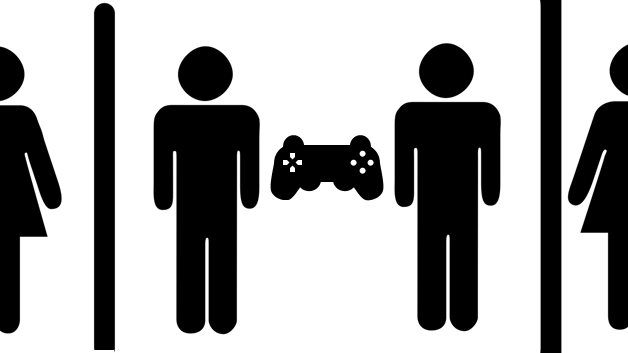
“Videogames are sexist” passes over my ears no different than “the sky is blue.” It’s obvious. But given the strident hostility towards the women combating sexism (most famously, Anita Sarkeesian) it seems that sometimes the obvious is invisible. And as the industry falls over backwards to laud “next-gen” tech and preview the umpteenth iteration of ‘man kills X number of people to achieve Y goal,’ Sarkeesian and other bloggers have begun connecting the industry’s creative stagnation with its distressing bond to sexism. Transitioning to the “next generation” doesn’t mean “adding more pixels” it means evolving equity, accountability and inclusiveness. Gamers, men specifically, rejecting these changes only impede the medium’s progress, adding to its troubles by unwittingly encouraging a misogynist industry debased by the very men playing its games.
Blogger Maddy Myers discusses this misogynist climate in what is perhaps the best take on Anita Sarkeesian and the Tropes Vs. Women in Videogames series. While Myers does capitulate to criticisms of Sarkeesian and the series to a degree, the crux of the article is recognition of “how difficult it is just to bear continuing to exist online” as an outspoken woman in hostile, male-dominated spaces. Myers writes “we see systemic, viral criticisms of female writers like Sarkeesian far more often than of their male counterparts. I cannot think of a hate campaign of a male writer that approaches what has happened to women writers, bloggers, and critics.” These cases are not isolated incidents but a pattern of behavior that unfortunately, many feminists have come to expect. As feminist blogger Lauren Rankin writes: “It’s frustrating to know that no matter how well-researched a piece, no matter how many facts we have to back up our assertions, no matter how clear the injustices are, feminists will have to wade through the ever-pervasive misogynistic and derogatory fodder that constantly follows us.”
This fodder not only normalizes misogynist hostility but impedes the dignity, legitimacy and maturity as a medium the industry has fought for. Maturity demands accountability. As researcher Daniel Greenberg said in The Atlantic: “We, the gaming community, need…to demonstrate how seriously we take not just our rights but also our responsibilities to society. We need to talk about pro-social games…” We don’t need any more grittiness or edginess or any of the other buzzword conventions we saw ad-nauseum at E3. And recently, including these conventions runs the risk rolling back onto the same lazy misogyny . Unfortunately, the project of social accountability is stalled by lazy, sexist ‘ad-feminem’ attacks that bypass structural critique for personal attacks on the women offering them.

Anita Sarkeesian and the Tropes Vs. Women in Videogames series
But what about the men? Yes, men do speak out against the sexism in the industry and even receive hateful attacks as well – consider Sam Killermann and Gaming Against Bigotry . But the undue authority of male privilege means that men arguing similar points as women face much less harsh scrutiny. In an interview with Gaming As Women , Destructoid editor Jim Sterling said that when commenting on sexism within the industry, “The worst I get is an accusation or two and the obligatory reminder that I’m a fat f— … far better than consistent hate campaigns and utterly vile personal attacks and threats. Whenever I do a video on sexism, at least one comment will always be congratulating me on how better than [Sarkeesian] I was. There’s an obsession with her, and I don’t understand it. ” As punishment for resisting the institutional status quo of sexism, men must endure trolling; women, terrorism.
That criticism of misogyny is met only with even more vitriol is symptomatic of a larger devaluation of women within the industry and the culture at large. Emphasizing the gender-specificity of these “hate campaigns” allows us to comprehend the totality of misogyny in the industry: from gaming’s complicity in rape culture , to the dismissal of women as “real” consumers to the devaluation of women who produce videogames to the towards the women who speak out against how entrenched in patriarchy this industry has become. Make no mistake, women in this industry are under attack by men who detract from the very criticism that can evolve the medium.
And from men like me. Which is difficult to admit; I’m a man, not a troll. I constantly write about gender and misogyny in the culture. I follow progressive blogs, praise sexual diversity and laud feminist studies. But feminists know to be wary of men hiding behind the “ally” distinction (too often they only detract from women’s voices) and in making it such a point to distinguish myself from the trolls, I realize I’m tacitly utilizing their fallacy. Women forward a structural critique of the industry, only to have it torn down by personal attacks. And when I encounter a structural critique targeted at men, I similarly re-emphasize onto the personal (my support of feminism) to dismiss my own complicity in institutional sexism. In designating myself as “different” from the trolls, I created a “good guys/bad guys” dichotomy: sexism is what they do. I don’t participate in hate campaigns or demand women prove their nerd-cred. I don’t contribute to sexism in the videogame industry. This is a dangerously myopic take on sexism that only perpetuates it. And something I’ve sadly seen before among men tackling sexism in the industry. Slate’s Chris Kirk said “A great deal of us are tolerant individuals who just want to be left alone to kill aliens in peace. But I also know that among us lurks a mass of cads who use the anonymity of the Internet to harass female players.”

The abject horror of the internet troll.
Sexism is not solely the prerogative of comment box cowards, nor is it limited to harassing women online. To perpetuate sexism in videogame culture, I need only contribute, wittingly or no, to the existent hegemonic status quo. And as a male in a male dominated space, I always already am. Even when speaking out against misogyny, my ethos is strengthened by a status quo that privileges and overvalues me(n). I may not be culpable for the targeting of Anita Sarkeesian, Leigh Alexander, Maddy Myers or Patricia Hernandez or dozens of other women but as a man, but I am always accountable.
Because even feeling comfortable and secure enough to challenge sexism is a privilege. As a hegemonic culture, empowering women – either female gamers or their virtual counterparts – disturbs gaming spaces because these spaces are not just for men; they’re for men to the exclusion of women. The erroneous and juvenile cops vs. robbers dichotomy is founded on the belief that only some actions are gendered and only some actions either perpetuate or resist the status quo. This is false. Our every action is gendered and by making sexism what “they” do, I’m omitting how power and privilege dictates my every act. Yes, every act. Yes, even nerd-raging over DLC or your favorite game’s release date. Every action.
Consider this: In a recent episode of his “Jimquistion” series, Sterling examined a distressing trend in game design and marketing, arguing “there’s a difference between a game being designed to be fun and then using that fun to appeal to gamers and a game cynically, coldly designed simply to sell copies to reach an audience and nothing else.” The primary difference is the answer to the question: “Does a game care about your enjoyment after you’ve bought a game, or does it just care that you bought it?” Increasingly, it turns out, the latter, with serious repercussions for gender relations. Remember that games, like any text, have a wide variety of possible readings and for games this is compounded by their interactivity. However, this “mass appeal” paradigm has created a design template which privileges a certain set of readings, features and ways to interact with the medium. The implementation of this template is obvious to players, who as Sterling describes, “can tell the difference between something made with genuine heart like The Last of Us and something made by ticking boxes on a…12 year olds [chart] like Resident Evil 6.” However, this template is created in the image of exclusionary male biases with largely unquestioned control of the development process. Even in a game made with “ heart .” There is certainly nothing new about marketing or focus-testing, but Sterling’s video highlights how explicitly reflexive the relationship between gamers and developers have become. The problematic elements in one reflect onto the other, resulting in a Pong-style cyclical masculinization and exclusion.
Joel, Ellie, Marlene and Tess in “The Last of Us”
Have you noticed how games seem to be getting more conservative even as the calls for diversity and change get louder? Starry-eyed by the bombastic sales of hyper-masculine games like Call of Duty, the industry appropriates this machismo into their games. The “mass-appeal” complex, dismissing the full potential of interactivity of videogame in lieu of a clinically business-minded appraisal of what sells, sees the violence, the misogyny, the overwhelming whiteness, etc. and creates games with these conventions embedded in the design template. These problematic design conventions are then normalized, becoming ubiquitous and invisible fixtures of the industry. And so when women, already outsiders to this industry, question these conventions, they are misinterpreted as attacking the medium itself, as the conventions have become so normalized they are not readily divorced from games. Thus as the gaming spaces shaping the discourse become more exclusionary and masculine, developers further masculinize the template, which is then reflected onto our spaces and in turn back onto our games. The games become more hegemonically masculine, the industry becomes more hegemonically masculine, the online spaces become more hegemonically masculine. All for the bottom dollar.
And that’s the trouble with we men. There’s a disconnect wherein players see the industry as a boy’s club “community,” while developers see a business and translate the problematic cultural paradigms of race, gender, into the products. This “community” perspective is the origin of the “it’s just a game” branch of shirking accountability. The “trouble” is as long as misogyny, racism, etc. are acceptable within the “community” our industry will reflect that. The logic is: I’m a part of the community, not the industry. This isn’t my fault – I shouldn’t be accountable. But our industry is as we made it. Institutional misogyny comes from a male-dominated industry reflecting and reproducing its own anxieties about women. For profit. And I don’t have to be a “bad guy” to support this – inaction is tacit acceptance. And that’s why men’s every action is part of this process and requires accountability. I urge men to consider the totality of sexism in the industry while they reflect on their role in ending institutional misogyny. Understand the connection between gender-conscious articles, in-game sexism and the mass-appeal-machine. Well, no – first things first – don’t be a jerk and threaten women with death or rape. Seriously. And remember while no one is blaming you personally for the sexism in the industry, if you truly love this industry, you have a duty to question its complacency. It’s not enough not to be a troll, gentlemen. We need to be men.
And that’s a big step. Primarily, it means some hard reflection. As blogger and critic Chris Franklin “If you really think games just need a functional [sic] review of mechanics/stability then you strictly view games as product & I feel sorry for you.” We men need to divorce ourselves from all the mental shortcuts of “it doesn’t matter” or “it’s not our fault.” These are more than just games. And we all know that. These dismissals impede the progress of the medium and betray our discussions of games’ evolution and potential as art. My hope is that openly discussing the full scope of institutional misogyny will create an environment of accountability which in turn will create socially conscious games. As collective calls for diversity begin to have more impact in the industry, the dialectic relationship can be utilized for open, pro-social dialogues (not templates) that transform games and propel the industry into the “next” generation of accountability, social consciousness and equity.


Pingback: OPTIONS: MALEGAZE: OFF | Sang- Froid Fussell ()
Pingback: New Games Online » This Week in Video Game Criticism: From nostalgia to jiggle physics ()
Pingback: This Week in Video Game Criticism: From nostalgia to jiggle physics » Gaming News Alerts ()
Pingback: CHRISZAMANILLO.COM » August 4 ()