
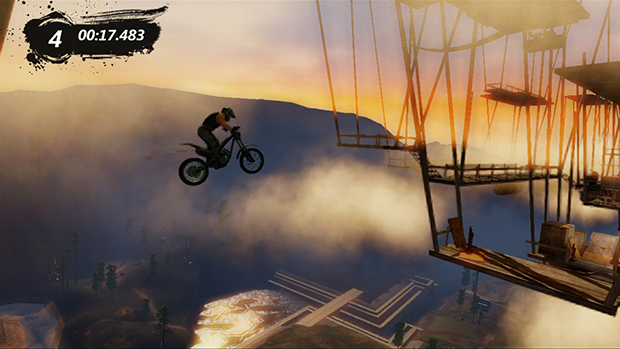
Moments of strange synchronicity exist in life. Sometimes, experiences that seem disparate also seem to have an underlying order to them, a point of comparison that unlocks each to the other. We’ve all had these moments in school, when your Econ prof seems to be in direct conversation with your Poli Sci class, or the Early Modern play you’re reading seems to have a lot to say about the upper level sociology class you’re auditing. I say so because it just happened to me – a point of synchronicity that is as obvious as it is random: I read J.G. Ballard’s Crash , a novel about fetishists whose sexual desire is tied to car crashes, while playing Ubisoft’s Trials Evolution (PC, XBLA), the motocross masochist dream.
Tim Rogers, in a recent article for Kotaku, suggests that what draws him to games is their sense of physicality and kinetics, saying “My ideal video games are muscle-memory buffets, silver platters piled high with the finger-food of 20-millisecond-long psychic screen / finger coordination contests.” For him, what appeals in a game is the feeling of “locking-in” an input chain, nailing the perfect combination of interactions in a way that feels right; this makes sense for the infamous critic and designer who coined the term “crunchy” to describe satisfying game mechanics. In this, Rogers presents somewhat counter-intuitive notion: games are, or should be, about involving the body.
Crash , on the other hand, is a deeply disturbing novel that is based on the abstraction of the body to the level of technology. The sexual descriptions in the book obsess with the sublimation of the grossest parts of the body (mucous, faeces, ear wax, wounds) to assemblages of steel and chromium. The characters in this novel discover that, after being involved in car crashes, that their sex lives are intimately entwined with their automobiles, revolving around and ultimately involving them. For the purposes of decency, I won’t quote the novel at length (you may think the movie is weird, but the book has a stomach-turning knack for description), but here is a sense of the violence of Crash ‘s sexuality:
“These unions of […] genitalia and sections of car body and instrument panel formed a series of disturbing modules, units in a new currency of pain and desire.”
The novel is an extended meditation on the ways that certain technologies mediate the body, changing people’s physical relationships as well as the experience of pain and pleasure. It’s worth noting that in this new network of desire, between “genitalia and car body,” pain is a key component.
This is where Trials Evolution comes in. It is a perfect example of the kind of game that Rogers describes, offering a smorgasbord of twitch reflexes and infinitesimal timing that lets the player feel like the ultimate badass when she finally completes a difficult section. The exchange of analog trigger pulls, slight adjustments on the joystick, and complex physics delivers a powerful cocktail of positive kinetic reinforcement so that when you finally land that loop-de-loop or triple flip, you feel it.
Trials is also notable because it is also, at its heart, a rag-doll game. The series emerged in the early years of the 21 st Century as an online Flash game, built on a somewhat simplistic physics model. It was successful in part because of the ridiculous contortions that the motorcyclist was forced into when his bike flips or crashes. To this day, a failure in the game results in an unpredictable faceplant along the lines of MXC ( Takeshi’s Castle , for the initiated) or Wipeout , television programs built on the spectacular tumbles of would-be athletes.
In the early days of Flash portals, games of this type were quite common, as they offered an appealing gimmick in the flailing limbs of the ragdolls contained within. In fact, playing Trials Evolution a decade later from these early days reminded me powerfully of this strange “game” by an anonymous author, known only as “Ragdoll” . There is no success or failure scenario to this curious virtual toy – the only point is to fling a woman’s body through an infinite field of bubbles. It would be difficult to get any numbers on this popularity of this program, but I remember it being as ubiquitous in the early years of the century as it was strange. While it certainly objectifies women in a possibly sado-masochistic way, it is also so singular and psychedelic that I’m baffled it was as commonplace as I remember it being.
The reason I bring up this idiosyncratic piece of gaming history is that I think it indicates something: the curiously masochistic pleasure of the mediated body. “Ragdoll” is incredibly rudimentary, a beginner’s effort in programming; what this seems to suggest is that if given a chance to recreate a body in virtual form, the first thing someone will try to do is hurt it.
Trials is a more sophisticated game than “Ragdoll,” especially in its third iteration. However, there is something that carries over from these early days of Flash gaming: the mutilation of the rag-doll. Trials makes this clear by making the wipe-out not only the price of failure, but also the reward of a job well done. In most levels, once one crosses the finish line and loses control of her avatar, there will be some elaborate trap that launches the ragdoll motorist into the stratosphere, drops him into a pit of spikes, or electrocutes him. The pain of the virtual body is both punishment and reward, and the pleasure for us as gamers comes in the cringe that accompanies the spectacle, the half laugh, half groan of seeing something that makes us wince in sympathy. In this moment of partial identification, the player appears to be both sadist and masochist, inflicting and feeling the pain of their avatar.
This ambivalent position is what Ballard projects as the fetishism of cars and technology in Crash . The characters in that novel are obsessed with wounds, mutilations and death – both their own and others’. In a memorably grotesque scene, two people recovering from crashes explore each other’s raw and sensitive, still healing scars as new genitalia. This physical sensation, coupled with the excitement of having mingled with the steel technology of the automobile, “drive” their coupling forward to climax.
In some ways, the motorcyclist of Trials represents precisely this fusion of flesh and metal. The controls for the game are relatively simplistic, offering two parallel forms of movement: thrust and brake, and the shifting of the rider’s weight forward and back. When playing the game, however, these two forms of direction , become intimately entwined; the player’s fingers barely recognize that they are performing separate inputs as the bike propels itself forward up a hill, adjusting its weight to keep its tires on the surface and performing a bunny hop wheelie at the apex. The rider of the bike is part of the machine, his straining a kind of muscular extension of the engine, and they separate only at the moment of crash. Similarly, the player herself is implicated as part of this hybrid, forgetting that she is holding a controller and staring at a screen. The avatar becomes part of the player through a moment of proprioception , and when the avatar crashes and that link is broken, there is a flood of affect, be it relief or frustration.
It would be easy to overstate the strength of this relation, and if I have done so here it is only to note the strange way that the physicality of the player emerges in the masochistic relationship to the avatar, in a way that exceeds simple “force-feedback” haptic responses. It is also tempting to suggest that the mediated body is the masochistic body, but that would again be drawing too strong a correlation. Instead, I think what the comparison of Crash and Trials suggests is that there is a tendency, or desire, to feel the virtual body through the experience of pain. (For further proof, take a look at Happy Wheels – a free game that is essentially Trials pushed to gory excess).
What I am comfortable suggesting is that this desire is frequently articulated in video games. The destruction of the grotesque bodies of mutants, zombies and villains throughout popular genres of games seems to suggest masochism reified into the revenge fantasy – itself a form of sadism. What these games seem to suggest is a desire to identify with the technology of the game-as-design (remember, “technology” means “study of technique,” or “craft” – in many ways, “design” is the purest expression of technology-as-such), the body must be mutilated or destroyed – and the games markets trips over themselves to find new ways to enact such violent fantasies.
Perhaps, then, discussion of violence in games needs to account for the idea that when gamers virtually bludgeon a body into pulp, what they are expressing is not simply a wish to do harm to others, but rather to become closer to the medium they love. I’m tempted to say that when I play Trials Evolution and cringe in sympathy for the poor motorcyclist on screen, that is a moment of “pure gaming,” when I am utterly involved with the virtual events on screen. I can honestly say that it is probably this high which keeps me coming back, and I’m willing to bet that this is true for others as well. If so, it should not be discounted in future analysis of the medium.
Further Reading: The Incredible Machine: Auto-Amputation and Incredipede
Difficult Video Games Are Like A Certain Kind of Sex (Kotaku)

