
“Be more objective.” This has become a common refrain both in internet and public discourse, a suggestion in discussions that someone’s position doesn’t matter because it isn’t “rational.” However, I think few people stop to think about what they’re saying when they say “objective.”
Certainly, we’re all well acquainted with the definition of impartial observation. But nobody tends to think about the “object” of “being objective.” In being impartial, are we becoming “objects,” transcending subjective biases in order to become something inert, or physical? Or, are we fulfilling an “objective,” acting purely instrumentally towards some end?
Games are well suited to think about the object, combining as they do virtual objects with clear objectives: manipulate these items so that you can arrive at point B, etc. One genre that presents the object most clearly the traditional adventure game, or the good ol’ “point-and-click. These games are all about collecting items and combining them in order to solve problems, demonstrating both implicit meanings of the “objective” in rare fashion. With this in mind, I want to explore two recent adventure games that provide some insight into the object: Resonance and The Dream Machine.
In Tune: Resonance and Shared Experience
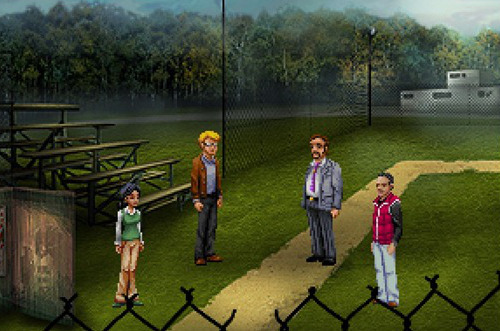
Resonance is a new game from Vince12 (a prolific game maker in the AGS community) released by Wadjet Eye Games , makers of the popular Blackwell series as well as AGS classic, The Shivah. Resonance itself is a polished piece of adventure gaming, a labor of love that takes its pick from a variety of tried and true mechanics in order to tell its story. In particular, it takes the multi-character format of the Maniac Mansion series, requiring you to juggle different people and their skill sets in order to solve its satisfying puzzles.
“Resonance,” the title of the game, refers in particular to the scientific macguffin of the game, a new technology that depends on distant particles vibrating sympathetically. Of course, this discovery will either save the world or destroy it, and the “science” of this innovation is largely hand-waved in order to bring the game’s cast of characters together and unite them in a purpose.
As with any good story, though, not everyone is actually following the same agenda, and this division the source of the narrative discovery – however, it is the cooperation of the characters that the title refers to most potently. These people are united, but imperfectly, “resonating” but still separate, brought together for a moment of shared existence. And, contrary to the game’s pseudo-science, the real damage is done when they stop resonating.
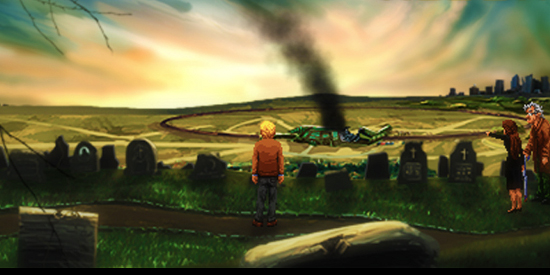
Objectivity is in many ways a fantasy of resonance – the notion that we all operate on the same field of existence, that it is possible for everyone to fit together as pieces in the same puzzle. The problem is, this fantasy flies in the face of personal experience, where everyone has a different understandings of the same things offered by different accounts and lives. To use a particularly loaded example, consider the American flag – an object that means something completely different for an American and, say, a citizen of Afghanistan. Objects are rarely neutral, because of the way they connect with our experiences.
Resonance recognizes this quality of the objective in an very interesting way – by making memories objects. The game has three inventories: the traditional one that is basically the contents of one’s pockets, but also STM and LTM – short term and long term memory. In a really interesting twist on the traditional adventure game, where one has to recall verbal or visual cues in order to figure out how to solve a puzzle, here the game’s characters have to remember how to solve a problem by remembering themselves. This change offers an impressively organic take on puzzle solving that reduces some of the insane logic by eliminating the need for outlandish items ( the rubber chicken with a pulley in the middle, for instance ). The most important objects in the game are a character’s experiences.
This sense of memory works really well with the game’s multi-character format, as only certain characters will have the experiences that allow them to progress past a certain obstacle; while “short-term memories” are shared between characters, long term memories are the possessions of certain characters alone, a fundamentally individual experience. When the player clicks on a long-term memory, a brief clip plays, a memory of something that happened in the past. When the player holds the mouse button and drags the memory, it interacts with the environment, becoming the nudge that allows someone to solve a problem, or a topic of conversation. It is one of the primary ways these characters are useful to one another – and as the game progresses, it is implied that long term memories (specifically, the ones we are not able to view or manipulate as players) that ruin the precarious moment of cooperation. Memories, in resonance, are one the most important tools, but also that which prevent a uniform playing field, where everyone works together perfectly. They are the path, and the stumbling block, to the objective.
It’s a promising mechanic that I would love to see explored further – for instance, it would be fascinating to have at least a puzzle or two produced by discrepancies in “shared” memories, sifting through individual accounts in order to settle an argument. However, Vince12 has done a great job of recontextualizing a classic mechanic in order to shed shed some new light on our assumptions. Many of its plot beats are predictable, but it uses the tools of game language to offer a new take on the “object.” I will mention here that the game’s focus shifts past “resonance” to a nightmarish account of the objective, a universal world of pure information, but to describe this would dive deeply into spoilers and I do recommend that you play the game. Instead, I’m going to turn now to turn to a game that offers a perspective into the purely subjective: The Dream Machine.

Adventure Game Dream Logic: Playing The Dream Machine
“Adventure game logic,” as a trope, suggests a game world that is fundamentally at odds with real world experience. Typically, this results in circuitous solutions to problems that could be solved in a much more straight forward fashion . The logic of adventure games is often weird, wild, and absolutely singular.
What is striking about puzzles that follow this bizarre sort of logic is that you aren’t just solving a puzzle – you’re figuring out how the developer’s head works. This is often a criticism – that you’re trying to guess at what the maker of the game wants you to do, rather than what would make sense to do, but in the best cases there is a joy in discovering the bizarre logic that someone else has concocted, precisely it is because it is so alien.
Perhaps this is why some designers of adventure games – notably Tim Schafer, gaming’s favourite teddy bear – are so fondly remembered, and why figures like Roberta Williams, Jane Jensen, Al Lowe and The Two Guys From Andromeda were early game celebrities (outnumbering recognizable figures like Will Wright and Sid Meier); you get attached to the people who made the games, because there is a genuine sense of “getting to know them” in playing their games.
Tim Schafer, of course, explores precisely this theme in Psychonauts, a game which is ironically his first major game that wasn’t a pure “adventure game” (although elements remain). This fertile ground, of getting to know someone from the inside out, is also shared by independent adventure game The Dream Machine .
Made by “Two Swedish nerds named Erik Zaring and Anders Gustafsson,” The Dream Machine is an as-yet-unfinished episodic series that is most notable for its gorgeous stop motion animation aesthetic, which perfectly complements the surreal premise: as the game continues, you begin to enter the dreams of the sleeping tenants of your character’s apartment building in order to roust an alien presence feeding on their dreams.
Here, “adventure game logic” is explicitly “dream logic,” that Freudian realm where anything could stand in for anything else, where the traumas and anxieties of an individual could play out and resolve themselves in a completely different scene.
In chapter three of this game, our protagonist’s young wife dreams of herself as the captain of a cruise ship where every employee is her husband. We can speculate wildly as to how this image may fit the character: perhaps she doesn’t feel in control of her relationship, and wishes to become so in her dreams? Perhaps the cruise ship is a symbol of relaxation? Contrary to popular belief, what Freud advises in The Interpretation of Dreams is that there is no easy answer; one has to spend the time to get to know the person, figuring out the rules and loopholes of his or her mind in order to figure out what symbols are being employed, rather than insisting that, say, the cruise ship is a penis.
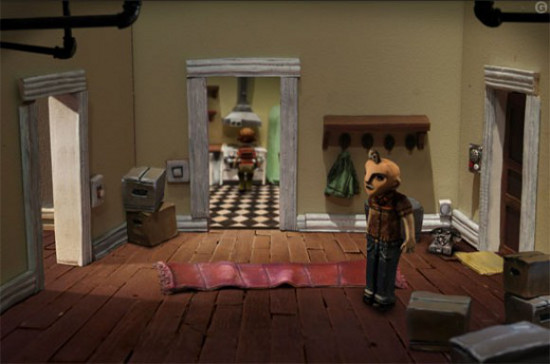
For all that, The Dream Machine is surprisingly grounded – while it offers some truly startling imagery, there is only one solution for any problem and they tend to actually follow “real world logic” – which makes it quite a good adventure game. Still, while certain aspects of dream logic emerge, it seems as if there could have been a remarkable union of idiosyncratic game logic with the dream logic it most resembles. I hesitate to call this a missed opportunity – because to marry game design with the purely subjective language of dreams could be a total disaster – but one does wonder idly at what a well executed union of these realms might look like.
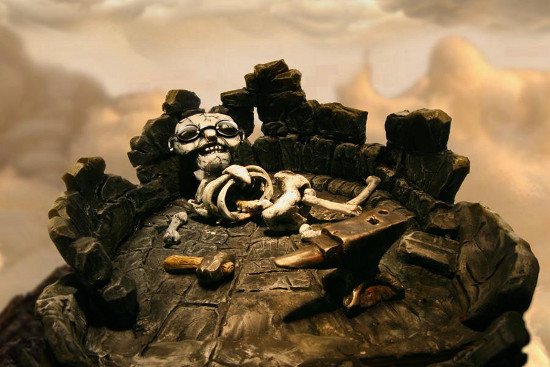
What is most interesting, though, for this article’s purposes, is that the game is literally objective, presenting clumps of clay, wood, wire and paint as the game world. Here, we see the merging of the subject with the object, the rendering of the inner world with the outer world. Perhaps the game’s greatest strength is precisely the uncanny sense of its aesthetic, the deep creepiness of seeing something very human rendered in such an inorganic way.
This union emerges in the gameplay and narrative; at one point, your character must correctly order generations of fathers and grandfathers (who exist as statues) temporally, visiting them in turn in order to maintain the system of lineage. This requires correctly figuring out the paths in the dream world they occupy, traversing uncertain passages in order to establish a proper hierarchy. In other words, recreating social order in an individual, setting the objects of his mind in place, becomes the object of the game, the character, and the player. In some ways, this could be understood as the “objective,” the transformation of a person’s experience into something external, or the imposition of something social onto something personal; an alien presence telling someone’s inner world how it should be.
The End of a Dream
“Be more objective” is a strange imperative, a call to be more universal. What these games demonstrate, though, is that as a cultural demand, the objective is subject to the abuses of experience and social order.
Games are almost purely objective, in that they offer us clear goals and ask us to work towards them. As such, they offer a fantasy of a world where every action is accounted for, where it is possible for every person works towards a universal goal. This fantasy breaks down pretty quickly once one exits the “reality” of the game, though, and it is to the credit of Resonance and The Dream Machine that they are able to recognize this within the bounds of their fictions.
These observations are not meant to discredit the objective, but simply to point out a little bit more about what is veiled in that concept, and to suggest that other realities exist – and also to suggest that perhaps the “object” is not the best way to communicate with another human being.
Sometimes, to really resonate with someone, you need to get inside their head.

