
by Kyle Carpenter
Alan Wake is an interesting game, one that received largely favourable reviews from critics but never seemed to quite find its audience. When people criticize the game, it is largely because of gameplay issues; most laud the narrative, suggesting that it is a gripping tale told well . I think that perhaps this is overstating the case, but agree that it is largely successful on the narrative front. What I want to add, however, is that it comes close to being horrifying as well.
Psychological Thriller: Jump Scares in an Unsettling Atmosphere
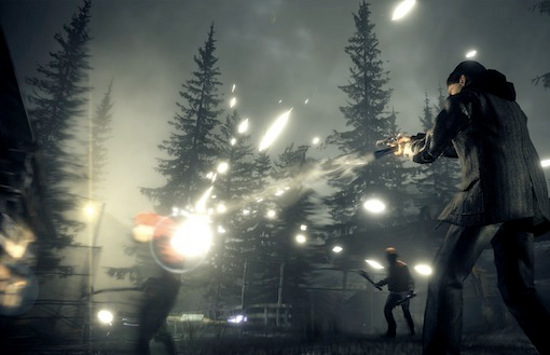
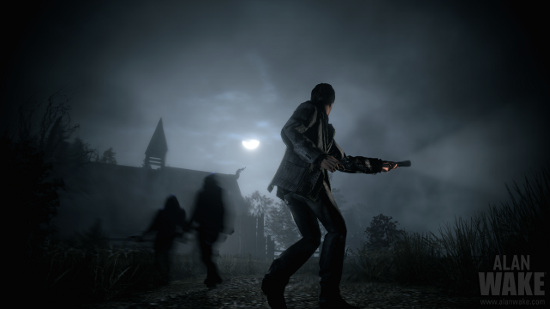
I’m proceeding from my colleague Karl Parakening’s distinction between “terror” and “horror”: “[t]error is the anticipation of something being revealed; horror is the realization or exposure of something once hidden.” Alan Wake does both, and this can be observed in its most typical combat scenario; Alan is running through the woods, alone, when a sudden, slow-motion shot reveals that he is surrounded by men brandishing axes, scythes, and other makeshift weapons. They begin to approach him from all sides in a circle, and Alan must shoot his way out.
This scenario succeeds on a number of levels. For one, the game’s rendering of the Pacific Northwest is eerie and beautiful – no mean feat for Finnish development house, Remedy Entertainment. The fog here is less a product of technical limitations, and more a pitch perfect way of showing the essential spookiness of a rainforest at night. Secondly, the way the game pauses momentarily to let the player realize their situation is a elegant play on the jump scare, playing into fears of unseen assailants emerging from behind every shadow. This is the terrifying element, that malevolent forces are simply waiting for their chance to reveal themselves. This remains frightening for at least the first third of the game (which, for horror games, is really not that bad of an average). However, as one learns to juggle the game’s systems, escaping the closing circle of men, corralling them, and picking them off one by one, the scenario becomes less scary.
It’s to the game’s credit, though, that there is something genuinely horrifying in the enemies that you face: indistinct men, faces obscured by shadows, who have been possessed by “The Dark Presence” and mutter snips of phrases from their previous lives. This is especially true for “boss” characters, people who Wake has met previously who speak in garbled voices, soullessly enacting their roles in life. One such character, a park ranger, declares “PLEASE don’t feed the ANIMALS,” and “FISHING is only PERMITTED for those VISITORS who purchase a park FISHING LICENSE.” The actor enunciates the words at strange intervals, chewing the scenery and giving the sense of language escaping out from the man.
Given this strange form of possession, it’s worth noting that “The Dark Presence” is figured as an “editor” at a few points – someone who helps dictates what a writer says.
What’s fascinating about these enemies is that they are all men, and identified by what they do: park ranger, salesman, lumberjack, hunter. What is unsettling about them is that there is nothing to identify them as individuals: their faces are obscured, and their voices are highjacked by words and phrases supplied by their position. This impersonality is the horror of Alan Wake; that you aren’t in control of your own life, that the things you think, say, and do have been supplied by some greater force, whether it be society, your editor, or your web of personal relationships. The question asked is “who are you really?” and the answer, the source of the horror is “the language that speaks through you.”
Half the Man I Used to Be: The Art of Autobiography
This is the uncanny situation Alan Wake finds himself in: discovering pages of a book that he wrote, but has no memory of writing. He recognizes that it is his work, but can’t claim it as part of his life. What’s more, these pages predict the situates that he is soon to encounter, suggesting that everything in his life is destined in some way. In one reading, this means that Wake has the ability to predict, or influence, the future. In another, more horrifying approach, it means that everything in Wake’s life is preordained, that there is nothing that he does which is not a product of the words that define him as a Writer.
At various moments throughout the game, Wake will encounter TVs that show an image of himself at a typewriter, writing the pages that he encounters throughout his journey. This TV self declares “A story is not a machine that does what you tell it. A story is a beast with a life of its own.” One thing that is interesting about these encounters is that these TVs present FMV, recorded with the actor who is the basis for Wake’s character model. This split presents a cognitive difficulty for the player: the writer in the TV is “more real” than the avatar we’ve understood to be the character himself. There is an uncanny shift here: Wake doesn’t exist in and of himself: the “Wake” is “out there,” somewhere other than the skin he inhabits.
This uncanny sense of being “out there” is common enough; aren’t we all afraid that the way people see us and the way we see ourselves don’t sync? This fear is portrayed in Alan Wake in a tape recording interview with the game’s psychologist character and Alan’s wife, Alice; in this interview, Alice presents a version of Alan that doesn’t really fit with our experiences of him. She says “He’s more and more out of control all the time. The parties, he’s so angry all the time, he’s getting violent…” While we have been privy to moments of tension in their marriage, notably over a hangover, there is little indication that Wake has been “out of control” – and yet, this is the version of him that his wife, his “muse,” presents when speaking honestly.
The interview continues, and the psychologist asks Alice what she would say to Alan if she could. What she says underscores this strange duality between the “inner” and “outer” self: “Oh, I don’t know. I want to say, I look at you, and it’s not you, just some stranger who resembles you, looking out from behind your eyes, and I don’t like that guy much, and now it’s all gonna go to hell.”
This “stranger” is revisited in the new game, American Nightmare, and taken in new directions, but in the context of the first game, it seems that Wake is not who he thinks he is. This opens radical new readings: in this story, Wake is at the centre of the world, an object of love, interest, and obsession for every character in the game. The only world in which this is possible is one’s inner world, the story you tell yourself to reassure yourself that you are not a “bad guy,” that you are loved. In this reading, Wake is indeed writing a story – but he is trying to hide the fact that he is doing so, in order to avoid the fact that he is not the centre of the universe, that he may indeed be a bad guy. He wants control over the way people see him, so that he doesn’t have to see himself.
If we expand this reading, the “taken,” those shadowy men without faces, are those who have given up control of their own identities, become simply the words they speak, the impressions they leave on other people. Instead, perhaps Wake is trying to make his words serve him, elevate himself above those who have been so fully “edited,” whose words only reflect their social bonds and no their “inner selves.” In this world, only “the Writer” has this power – everyone else is part of the story.
The End?
It’s interesting that this anxiety emerges so powerfully in a game that borrows so much from other sources: Stephen King, Twin Peaks, and countless other examples of “American Horror”; in a way, the game’s voice is not its own, as it is very much borrowed. What’s also striking is that the veil is never actually lifted: Alan finishes his story, and doesn’t come face to face with his wife; the horrifying thing that is hidden, that is almost revealed and hinted at in the game’s paratexts and implicit in its scenario, never comes to be. The next major chapter, American Nightmare, casts Wake as “The Champion of Light,” an avenging hero, banishing the wicked in a much more action-oriented title. It’s an interesting design choice, and one that I respect – again, it could be read as Wake descending even deeper into his delusion.
Still, nothing is ever revealed – only those brief moments of discomfort that indicate that perhaps something isn’t right, that perhaps Wake’s tale is the one he WANTS to tell you rather than the truth. The horror of the game is banished and controlled – at the same time as the player begins to manage the threat of the game’s enemies, Wake is able to contain the threat of his loved ones, the perspective they provide on who he is. He does this by writing a happy ending.
In all, that’s not a bad story. But it’s not a horror story – not until the veil drops, revealing something terrible that will not be ignored.
Only then does a story reach out from the page and really change something.

