

Indie Game: The Movie has been released to rave reviews across the board, and for good reason – it is a solid piece of human drama, and a fascinating glimpse into the working process of some very interesting people who have become beacons in the video game landscape. After watching it, I can honestly say that I would really like to have a drink with Edmund McMillen, watch sci-fi movies with Tommy Refenes, and have formal English tea with Jonathan Blow. But perhaps most impressively, Indie Game: The Movie let me like Phil Fish.
Fish, the IGF-darling-turned-internet-whipping-boy, has had a rocky few years, and Indie Game does a lot to show the human side of the angry tweets, the dismissive comments, the tendency to make public opinions which perhaps should remain private. What the movie is able to portray is a young man – he’s almost certainly in his 20s – who is understandably amazed by how poorly people treat him and lashes out. Of course, the film does some work to ignore his complicity in this internet rage – a brief glimpse at his (now dormant) twitter account reveals 20-30 tweets a day, many of which are bilious attacks on his aggressors. Still, what comes across clearly in Indie Game is that Fish was in way over his head, reacting in understandably, if poorly advised, personal ways to a reception that had very little to do with him as a person.
Of course, Fish has been redeemed in the most effective way possible: Fez is a critical and commercial success. Something that deserves comment in the game’s reception, though, is that Fish et al at Polytron did not seem to be the only ones celebrating; one could almost hear the collective sigh of relief as games journalists declared “it’s good.” Nowhere is this more evident than in the fact that reviews of the game tripped over themselves to write its accolades, competing to give it laud. This prompted Jim Sterling, among others, to ask “ are we too generous to indie games? ” What I think is obvious in all this is that there is a genuine enthusiasm for indie games among the gaming press, a desire for them to be great, in some way, to break new ground, to “redeem” the market as a whole.
This desire translates into a desire for indie creators to be something more than simply people making games. For instance, even though Indie Game: The Movie does a relatively good job of making the creators it showcases seem human, it does present Jonathan Blow as something akin to a holy man, whose every thought and utterance is a little more original, a little more insightful, and a little more sagacious than your “average joe” (a friend of Anna Anthropy’s described him, apparently, as the movie’s “Yoda” ). This tendency in portrayal indicates the desire not for just for creation, but for “genius,” that ineffable, heroic quality that is the hallmark of the “true artist.”
So is Phil Fish a genius? I don’t believe so. But it is worth asking why he has to be, and this question which will help us understand Fez’s reception, Fish’s reputation, and our own assumptions about creation and authorship a little more fully.
Of His Works
I first encountered Phil Fish in the February 2008 episode of the dearly missed 1up Show (the latter half of the video above is dedicated to the IGF, and Fish is writ large in their coverage). I remember at the time being very excited about “indie gaming” as a concept, and there is a palpable excitement in this video; here, the IGF is treated as an antidote to the bloated GDC (I love that the symbol of that event’s excesses is the “cube of meat”). This episode treats indie development as a “renaissance,” a return to the beginnings of the games industry, where small groups of people can make things that are interesting to them and not have to sell millions of copies to be a success. Even at this early stage, though, this “rebirth” was only half of the story.
The other aspect of this video which I think needs to be noted, is that it is “cool.” I remember at the time being particularly excited that games didn’t have to be a purely shameful, nerdy activity – you could be interested in games and have some crossover subcultural appeal. This seems so obvious now, what with Killscreen being partnered with Pitchfork, but to that point my collection of Every Game System and Most Games was more a secret shame than a merit badge for the cool kids club. Video game iconography was creeping into pop culture, and loving Mario and Zelda could potentially be as cool as going to see local bands play. The 1up show itself was a great example of this changing subcultural landscape: the intro theme is catchy and fun, everyone featured in the video is dressed well, and they all seem just as capable of commenting on the strengths and weaknesses of prominent San Francisco DJs as they can JRPGs.
This was very much a changing milieu at this time, and it is in this scene that Phil Fish emerged: a man who looks fetching while wearing a scarf and Ray Bans, showcasing an innovative game that is steeped in tradition and nostalgia. When indie developers were showcased on the 1up Show and elsewhere, they were all remarkable as cool and attractive individuals: Joakim Sandberg (Noitu Love 2), Derek Yu (Spelunky), Dylan Fitterer (Audiosurf), and Jenova Chen (Fl0w) were all interesting, young, and energetic in ways that more corporate developers were not. The camera loved them. Looking at this episode, it seems that there was a degree of delight in showcasing these handsome, excited young men who are as interested in hip music as they are games (I don’t think it’s a coincidence that Matt Chandronait notes the marriage of game design and audio when describing IGF).
For all that, though, there is no indication yet of the demand for genius – while Fish comes across as one of the world’s biggest hipsters here, there are little to no stakes yet. During the interviews that take place in this episode of the 1up show, Fish hasn’t yet won at the IGF (although he would the day after the interview), and there are few expectations placed on him. Rather, he appears to be an upstart “one of us,” a relatively cool guy who is doing something interesting in a promising new field.

Of His Martyrdom
In the coming years, all this would change. “Indie Games” would cement a reputation not as a new possibility or a re-articulation of gaming’s genesis, but rather as an entrenched style in and of itself. A new pattern of regard for creators was introduced in this period, where those early progenitors of indie gaming were hailed as founding fathers, revered pillars of the community who were part of an “inner circle”: Blow, Fish, McMillen and Anthropy, among a select few others. These two phenomena, the establishment of indie as a style and the lionization of its key figures, are deeply symptomatic of each other.
The image of the “indie game” became, in some ways, an antidote to Roger Ebert’s famous assertion that “games can never be art.” While it may seem old hat to bring up this battered and worn document, it’s important to remember just how influential it was and continues to be. In this case, we can see the emerging figure of the “indie game developer” as a way of rebuffing Ebert’s criticisms, which were primarily arranged by a definition of art as an intentional product of an individual’s creative vision. Although Ebert dismissed Braid in his article, citing (quite rightly) its “fortune cookie writing,” it is also one of the first examples given in the comments to defend games as art: user “Poncho Peligroso” cautions Ebert “Braid is not something to be dismissed,” before offering a close reading of the game’s message. In this comment, and others, gamers defend the artistry of games by appealing to the intention of their (sole) creators, appealing to the individual responsible for the vision of the creative work.
In other words, in order to prove that games are art, gamers produced artists.
This is what changed for the emerging conversation of indie games: as these games became cultural milestones, they were no longer simply the work of creators. They became the Work of Authors. In other words, these newly formed celebrities were allotted a degree of auteurship that could elevate the work of games from “consumer product” to “art.” They became flagbearers for a medium trying to justify itself to what was perceived as a hostile world.
Phil Fish, who looked, acted, and sounded every bit the “artist,” was, at the time, the perfect person to fill this new function. He had gotten in on the ground floor, and was known to hob-nob with all the other successful auteurs. The only problem was that he hadn’t produced a finished product yet, and there was little idea as to when he would be finished. Still, it is extremely easy to see that over the period of Fez’s development, the stakes had been raised.
What is amazing about this, though, is that even without a product, Fish made this transition by fulfilling a classic archetype: the tortured artist . I don’t think Fish decided to act in a certain way to fulfill market expectations; I believe that his anger, frustration, and anguish were genuine. However, the image of Fish that was generated by these responses was nevertheless pitch perfect for fulfilling the emerging demand for authorship and genius, tying into cultural narratives about the uncompromising “true artist” who will not bow to market demands, no matter how miserable he may become. When asked what he would do if Fez was never finished in Indie Game: The Movie, Fish responds with an unwavering stare: “I would kill myself.” While I don’t doubt his conviction, it also strikes me that in moments like this, he is performing this artist’s role fully and authentically.
If Phil Fish did not exist, we would have invented him.
Of course, in some ways “we” (“gaming culture”) DID invent him: the distance between the performance of the artist and the lack of any finished product raised the ire of an internet culture that will lash out at any perceived “pretense,” and Fish’s polished Montreal hipster aesthetic became a target for ridicule in forums and comments everywhere. Giant Bomb forum user AhmadMetallic writes “ just by looking at his face in the profile pic of his page i find him annoying ,” in an example that illustrates the distaste for “scenesters” in online discourse. This resentment fueled many of the attacks on Fish on Twitter and in comment threads, using his style of dress and “pretensions” as fuel for a round dismissal of not only his project, but him as a person. It is well recorded that Fish did not respond well, and his now deleted tweet on winning the IGF for a second time in 2012 will live in infamy: “”i just won the grand prize at IGF tonight. suck my dick. choke on it.” This, and a long history of examples of his lashing out at anonymous internet critics, helped cement the public perception of Fish as a complete and utter asshole.
What I want to highlight, though, is that this perception was the result of conflicting expectations of what Fish should be, as a creator. On the one hand, Fish is an author par excellence, whose image and ambition mirror the desire for games’ credibility; on the other, he is an iconoclast and public figure who is incapable of weathering the abuse and criticism of the online sphere. My argument is that both aspects of Fish’s persona are symptoms of the same image, viewed from different demands: one perspective wanted Fish to be an author, present in all his ego and glory; the other wanted him to be mild and accommodating, delivering products and responding to user feedback. The internet, as a multitude of voices united into a single, schizophrenic voice, made the impossible demand of Fish and his public persona: be everything for everyone, and also entirely yourself.
In other words, be a genius.
Of His Miracles
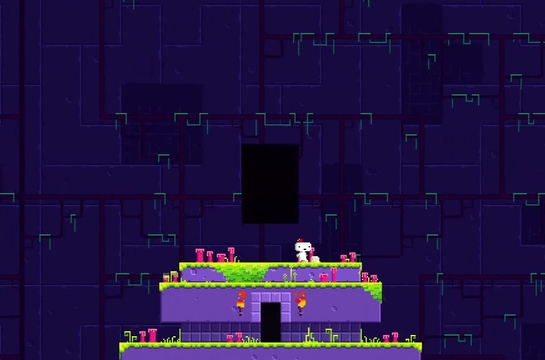
Fez is a beautiful game. The pixel work is gorgeous, the colour palette is refined, and it is incredibly atmospheric. Fish’s strength as a visual designer is apparent everywhere – and if Indie Game: The Movie is to be believed, part of the game’s long development time was due to Fish’s perfectionism; apparently, he redid his pixel work over and over, until each tetromino that constructed the world was just right.
The other aspect of the game that contributed to Fez’s 4 year development cycle was its game design: while the 2D/3D mechanic was maintained throughout, the concept of the game shifted from a puzzle platformer to a puzzle game with platform navigation. This shift in game direction could be read as a response precisely to the increased stakes of his reputation; Fish felt the need to be a genius.
In his final product, the metaphor of the perspective shift is expanded to the fabric of reality: Gomez, the lead character, can see through dimensions in a way that others can’t, and the puzzles of the game have to do not only with shifting the camera perspective, but also decoding the hidden language of the universe. The “reboot” is an integral part of the game narrative, a comment on the fabric of the world as a program, and the game’s final puzzle is supposedly deciphering the “64-bit name of God.” Fez wants you to know that it is Deep Stuff .
However, this cryptography is essentially hollow: you may be able to decipher hidden languages, but they don’t communicate anything resembling genuine knowledge. QR codes may be hidden in the game, but they don’t offer, say, any insight into the world Gomez inhabits – all they do is show you an input series that give you another collectible. The ending of the game is an abstract light show that suggests “the fabric of reality” as in the end of Kubrick’s 2001: A Space Odyssey, but lacks the meditation on human nature, cruelty, and progress that that film so carefully constructs. God’s name may have 64-bits, but that doesn’t mean it communicates anything essential about Her nature.
Instead, the spirituality that Fez offers parallels the “blue pill, red pill” dichotomy of The Matrix, and is every bit as naïve; if anything, Fez invites you to an illusion of depth, the suggestion that amateur cryptography is equal to meaning. This equation is not in any way a problem – it certainly has its pleasures – but what seems unavoidable in Fez is its desire to blow your mind, without any real ammunition for doing so. A game that knows it’s a game is still a game, not a metaphysical communiqué.
Hallelujah
What is clear in all of this is that Phil Fish, as a public figure, was crucified on his own ambition. There is a schism between the game he wanted to make and the game he made. It is also tempting to speculate that there is a similar divide between the man he wanted to be and the man he is, but to suggest this would be to participate in reinforcing the myth of the author, making the faults of the work the faults of its creator.
For all this, I want to leave on a gentler, final note supplied by Leonard Cohen, who – as the prototypical example of the Montreal Hipster – is Fish’s spiritual godfather:
“What is a saint? A saint is someone who has achieved a remote human possibility. It is impossible to say what that possibility is. I think it has something to do with the energy of love. Contact with this energy results in the exercise of a kind of balance in the chaos of existence. A saint does not dissolve the chaos; if he did the world would have changed long ago. I do not think that a saint dissolves the chaos even for himself, for there is something arrogant and warlike in the notion of a man setting the universe in order. It is a kind of balance that is his glory.”
It’s time to stop heroicizing Fish, who never seemed to achieve much in the way of balance, but it is also time to stop vilifying him. Ultimately, I believe both responses are part of the same phenomenon. Still, I think it is fair to say that in the long production of Fez and its sustained chaos, he did achieve a sort of a remote human possibility. Fez didn’t change the world, nor is it a work of genius – but it is insane to demand those things as the hallmarks of success.
Instead, we got a very cool game by a handsome guy who can rock a pair of Ray Bans. That ain’t bad. And if there’s a lesson in all this, something to be learned from Fish’s “sacrifice,” it’s that questions of art and genius are not binary propositions, and shouldn’t be. There is worth in the creation, even if it doesn’t change the world; a change in perspective might be enough.
The illustration for this article is courtesy of Tyler Witzel, whose email can be supplied to anyone interested in commissioning his work.
Further Reading: The Pros and Cons of Being Indie (Medium Difficulty)

