
by Adam Boffa
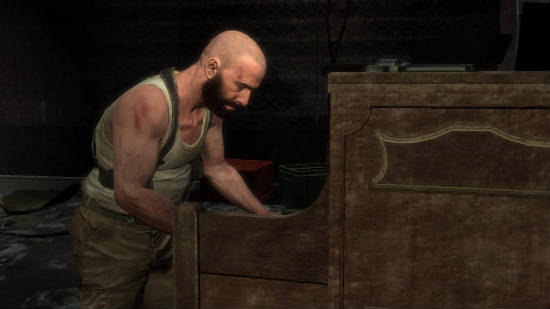
Max Payne 3 is a brutal game. But I do not think it is a stupid one.
Since its release, many players have (rightfully) commented on its excessive use of violence and the miserable, almost pitiable nature of its main character, which seem to be at odds with each other. What happened to the self-aware, fourth-wall-breaking attitude of the previous games in the series, and why was it replaced with such blaring ludonarrative dissonance ?
It is certainly absurd to think that a man this mired in depression and substance abuse would be capable of a seemingly superhuman capacity for avoiding bullets and similarly superhuman precision with a weapon, granting him the ability to shoot grenades and rockets out of the sky while hanging upside down from the bottom of a helicopter. This is to say nothing of the hundreds of men he murders throughout the game. But I’m not convinced that Rockstar’s writers are ignorant about these issues. Instead, they have just attempted to address them in a slightly more subtle fashion than the series’ previous developer, Remedy.
Max himself seems to be a commentary on exactly the type of character the player controls in this and so many other games, including this game’s own predecessors. What would a man look like after his wife and daughter were murdered and he sought revenge by killing a small town’s worth of people? Assuming he wasn’t a complete sociopath (which, admittedly, is assuming a lot about any game character), he probably would be in pretty bad shape. He might be plagued by depression and resorting to alcohol and drugs to fight off his demons. And he probably wouldn’t be very interested in the company of others while he’s at it. Sounds a lot like the Max we see here.
But medium is important, and this is not a film or a play or a book. This is a triple-A, hundred million dollar game, which requires a completely different approach and demands that its main character be capable of more than just gratuitous self-pity. Max must be a killing machine because that is what is expected of him, both narratively and mechanically. Again, Rockstar is not oblivious to this incongruity.
As written by Rockstar, Max is keenly aware of the bizarre cycle his life has been spinning in for the past 14 years. “Perhaps this was my punishment from the fates,” he says during one slaughter-filled visit to a favela in São Paulo. “Keep reliving the same mistakes for all eternity.” He notes that he is not good at anything apart from killing. Later, on a boat trip in Panama that goes murderously awry, he refers to himself as the cabaret act for the ship’s rich, drunk patrons. “Shooting whatever came in front of me was easier than coming to terms with that reality,” he admits. Really, though, Max is our cabaret act, and he knows it.
ockstar is aware of these dissonances and makes repeated note of them through Max. None of it ever reaches the directness of Max’s acknowledgement that he is a computer game character, as seen in the first Max Payne game, but maybe it doesn’t need to go that far this time around. Rockstar isn’t in the business of making statements in that manner, although it is certainly in the business of making statements. Max Payne 3 seems to be making a few, one of which might concern the state of video games and the shooter genre.
Max, a former NYPD officer, encounters another ex-cop a few times throughout the third game, who seems to represent the lifestyle Max could have lived if he hadn’t been the star of his own video game series. Squat, talkative, and eager to make friends, he is on vacation with a wife and daughter who are both alive and well. Max responds to this individual’s introduction with characteristic mocking in his internal monologue. “Give me a fucking break.” Whether we realize it or not, we feel the same way. After spending 60 bucks, who would want to play through that guy’s life story?
After all, despite the years of complaints about the homogenization of gaming thanks to endless sequels and the ubiquity of the shooter, Call of Duty: Modern Warfare 3 sold six and a half million copies in its first 24 hours on sale, to use just one example. Rockstar seems to be pointing us in the direction of an uncomfortable realization: when it comes to triple-A titles, audiences play those that glorify violence because they are often more exciting than the alternative.
Towards the end of the game, Max has another moment of self-awareness and slyly breaks the fourth wall. He plays a piano (one of a handful throughout this game and the rest of the series) and stumbles through a simple rendition of the series’ main musical theme. “And there it was, the soundtrack to my life,” he says. “And for a moment, harmony came.” That moment doesn’t last long. It can’t. But maybe it isn’t supposed to, anyway. Max, like so many others, has been condemned to life as a video game hero. It usually isn’t pretty.
